

The Reproductive Health Coalition (RHC), co-founded by the American Medical Women’s Association and Doctors for America (DFA), is a wide-range of health professional associations and allied organizations who advocate with a unified voice to protect access to reproductive care. We represent more than 200 healthcare and allied groups with over 150 million members.

The RHC, AMWA, and DFA are working to transform how we talk about access to abortion care—grounding conversations in empathy, evidence, and shared values. By equipping clinicians and advocates with influence skills and powerful narratives, we aim to reframe abortion not as a debate, but as essential, compassionate healthcare rooted in the lived experiences of patients and providers alike.
Join us and help transform the landscape of reproductive care access.
These trainings do not need to be taken in order.
Supported by the Collaborative for Gender + Reproductive Equity (CGRE).
Introduces evidence-based strategies for having empathic, values-driven conversations that support respectful, patient-centered care. Skills are applicable across reproductive healthcare and other areas of medicine.
Based on the work of Dr. Lisa Harris and Goodwin Simon Strategic Research
Builds practical communication skills for navigating complex and emotionally charged conversations with empathy and clarity. Participants are encouraged to continue with the live virtual workshop.
Based on the work of Dr. Lisa Harris and Goodwin Simon Strategic Research
An interactive workshop that deepens skills introduced in Part IIa through discussion and practice. Upcoming sessions are offered throughout the year.
Become a trainer for Navigating Conversations in Reproductive Care. We’ll give you all of the assets to effectively host a training of any size. Low time commitment. Be part of the change in reframing conversations in reproductive health so that they are grounded in empathy.
The Fellowship Program is a leadership and advocacy program for clinicians and advocates focused on communicating about reproductive healthcare with confidence, compassion, and evidence. Fellows learn to depolarize conversations, build trust, and foster meaningful dialogue that supports access to care.
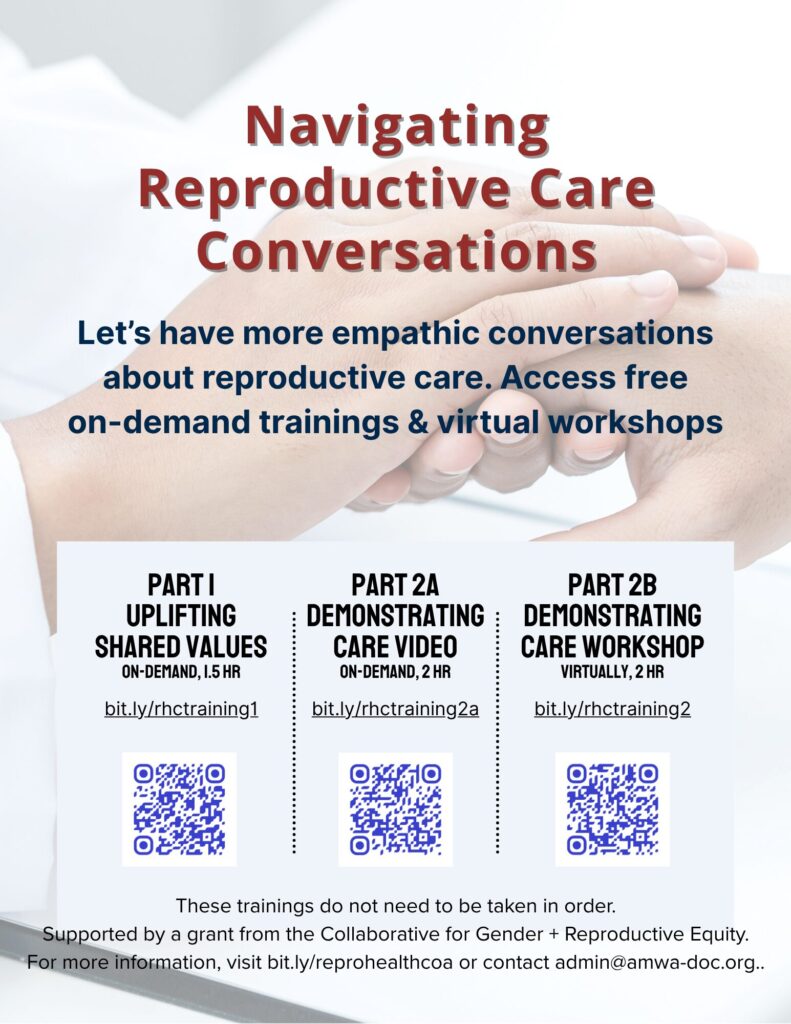
Download the Flyer at bit.ly/rhcnavigating.
Second Tuesdays · 12–1 pm ET
Monthly updates from member organizations and guest speakers on advocacy opportunities and emerging issues.
First Tuesday of each month
Strategic planning and coordination for Coalition leadership.
Fourth Tuesday of each month
Focused working groups supporting advocacy and education efforts.
Please add suggestions for additional articles here: https://form.jotform.com/230222912424040
General
Abortion is health care and a health equity issue.
A Preview of the Dangerous Future of Abortion Bans — Texas Senate Bill 8 (NEJM)
Cardiology
Abortion rights get to the heart of the Doctor Patient Relationship (MedPageToday)
A patient with preeclampsia has a risk of maternal and fetal mortality – complex, nuanced decisions must be made.
Implications of Restricting Legal Abortion Access on Cardio-Obstetrics Care (ACC)
Cardio-obstetrics patients are at risk for significant CVD-related morbidity and mortality.
Q&A: Anti-abortion laws and implications for pregnant patients with CVD (Healio)
Cardiac conditions may lead to abortion to save a woman’s life.
Cardiologists Concerned for Patient Safety After Abortion Ruling (Medscape)
Dermatology
The Supreme Court abortion ban impact on dermatology (JAAD)
If a patient accidently gets pregnant while on teratogenic medications, abortion is often recommended.
Gastroenterology
On the importance of safe access to reproductive options for adolescents and women with liver disease (Gastroenterology)
Nephrology
Dobbs Ruling Puts Kidney Patients in Jeopardy (National Kidney Foundation)
Neurology
Reproductive Rights in Neurology—The Supreme Court’s Impact on All of Us
Some neurologic drugs (e.g. Valproic acid) are teratogenic.
Abortion Ban May Mean Denial of Effective Drugs for Women with MS, Migraine, Epilepsy (UCSF)
Oncology
Treating Cancer in Pregnant Patients After Roe v Wade Overturned (JAMA Network)
Abortion is often needed before cancer treatment can begin.
Supporting Patients with Cancer after Dobbs v. Jackson Women’s Health Organization (Oncologist)
Abortion Ban May Increase Risk of Death for Pregnant Women with Cancer (UCSF News)
Ophthalmology
Even Exceptions To Abortion Bans Pit A Mother’s Life Against Doctors’ Fears (FiveThirtyEight)
Treatment for sight threatening ophthalmologic disorders may negatively impact the fetus.
Pediatrics
AAP supports adolescents’ right to comprehensive, confidential reproductive care (AAP)
Pulmonary
Pregnancy Considerations in the Multidisciplinary Care of Patients with Pulmonary Arterial Hypertension (J Cardiovasc Dev Dis)
Patients with severe PAH are often opt to terminate the pregnancy due to the high risk of maternal decompensation.
Access to Medically Necessary Reproductive Care for Individuals with Pulmonary Hypertension (Am J Respir Crit Care Med)
Rheumatology
US anti-abortion laws may restrict access to vital drug for autoimmune diseases, patient groups warn (BMJ)
Patients with autoimmune conditions report trouble accessing drugs that have “abortion inducing” potential.
Transplant Medicine
Navigating the Dobbs Versus Jackson America for Patients with CKD and Kidney Transplants (JASN)
National Transplantation Pregnancy Registry: Analysis of Pregnancy Outcomes in Female Liver Transplant Recipients (Liver Transplantation and Surgery)
Impact on Staffing
Hospitals Fear Abortion Bans Will Worsen Staff Shortages (Bloomberg Law)
AMWA Attends Rally with Vice President Kamala Harris One Year Post-Roe
Doctors for America (DFA) and the Reproductive Health Coalition (RHC), of which AMWA is a co-founder, file new new amicus brief at the U.S. Supreme Court in support of FDA’s approval of the use of mifepristone to end pregnancy through ten weeks gestation, without draconian prescribing and dispensing restrictions. Read more.
Washington, D.C.— Doctors for America (DFA) and the Reproductive Health Coalition [which was co-founded by the American Medical Women’s Association (AMWA) and DFA] have filed a new amicus brief in support of FDA’s approval of the use of mifepristone to end a pregnancy through ten weeks gestation, according to a press release issued April 12. Read more.
The brief, filed in the U.S. Court of Appeals for the Fifth Circuit, is in response to the decision made last week by Judge Kacsmaryk in the case of Alliance for Hippocratic Medicine vs. U.S. Food and Drug Administration (FDA), in which Judge Kacsmaryk ordered the FDA to stay the approval of mifepristone. Both Doctors for America (DFA) and the Reproductive Health Coalition (RHC) are deeply concerned that the decision made by Judge Kacsmaryk is not based on medical science, nor the robust data available. Mifepristone is a medication that has been safely used by physicians and patients for over 20 years, with research showing that adverse events and outcomes are exceedingly rare, occurring in less than a fraction of 1% of cases.
Doctors for America, AMWA, and the Reproductive Health Coalition are alarmed by the ramifications that potential loss of access to this medication will have on patients and clinicians. The brief filed in the Fifth Circuit provides first-hand physician testimonies on potentially devastating impacts on patient safety if mifepristone were temporarily or permanently taken off the market. DFA and the RHC are deeply concerned with Judge Kacsmaryk’s decision to stay the approval of a FDA-approved medication, as this decision undermines the FDA’s authority and sets a dangerous precedent for future drugs and therapeutics to be removed from market based on politics rather than patient harm or lack of efficacy.
The brief was filed by Dallas attorney Thomas Leatherbury with assistance from Columbia Law School’s Science, Health & Information Clinic (SHIC). SHIC provides pro bono legal help to DFA. Columbia Law student attorneys Emily Davidson and Matt Tracy led work on the brief, with support from student attorney David Ratnoff, and SHIC Director Christopher Morten. The full brief as filed in the Fifth Circuit Court of Appeals can be found here. DFA’s earlier amicus brief filed in the U.S. District Court for the Northern District of Texas in February in the case of Alliance for Hippocratic Medicine v. FDA can be found here.
Day of Action and Vice President’s Rally
About the Reproductive Health Coalition
The Reproductive Health Coalition represents a wide range of health professional associations and allied organizations that advocate with a unified voice to protect access to essential reproductive care. The tenets of this work focus on: a patient’s right to dignity, autonomy, privacy, and the expectation of a trusted relationship with their clinician; protection of the clinician’s ethical obligation to provide care, including their access to comprehensive training; and a commitment to an evidence-based approach to policy and practice. Over 40 organizations participate in the RHC, collectively representing more than 150 million members.
States with abortion bans or restrictions have:
States with abortion restrictions have:
Source: The Impact of Hostile Abortion Legislation on the United States Maternal Mortality Crisis: A call for increased abortion education (Public Health)
“Maternity care deserts are counties where there is no access to birthing hospitals, birth centers offering obstetric care, or obstetric providers…
Over 35% of counties are considered maternity care deserts. This means that in 1,104 US counties, there is not a single birthing facility or obstetric clinician.
(Nowhere to Go: Maternity Care Deserts in the US (March of Dimes, 2024)
“The United States continues to have the highest rate of maternal deaths of any high-income nation…And within the U.S., the rate is by far the highest for Black women. Most of these deaths — over 80 percent — are likely preventable.”
(Commonwealth Fund Issue Brief, 2024)
Impacts to maternal health can have a ripple effect on the health of future generations.
Voices from the Silenced: Pre-Roe Abortion Stories is a powerful documentary that sheds light on the hidden history of abortion before Roe v. Wade. Through firsthand accounts, the film amplifies the voices of individuals who sought or provided abortions in an era when access was restricted, often at great personal risk. These deeply personal stories highlight the challenges, dangers, and resilience of those affected, offering a critical perspective on reproductive rights and the ongoing struggle for safe, legal abortion care.
State Regulations: There are many resources available to track state legislation on abortion which can change from year to year.
Lawyers for Good Government State Overview
Center for Reproductive Rights
Reproductive shield laws are legal protections designed to safeguard healthcare providers, patients, and supporters from civil or criminal penalties when accessing or providing abortion care, particularly across state lines. These laws prevent states with abortion bans from prosecuting or penalizing individuals for seeking or offering legally protected care in jurisdictions where it remains legal. As attacks on reproductive rights escalate, shield laws serve as a crucial defense against legal threats, ensuring continued access to essential healthcare.
Communication Tools
Ally Voices Matter: Protecting Reproductive Care (Video, AMWA)
The Ladder of Inference (Systems Thinker)
Living the Humanity of Life and Choice (Braver Angels)
‘If we could get past this issue we could talk about almost anything’: Here’s how the Jessamine County Alliance dove into a heated issue (Braver Angels)
Getting the Edge: Proactive Abortion Messaging to Seize the Debate (Reproductive Freedom for All – formerly Naral Pro-Choice America)
Guide to Language and Abortion (ACOG)
Perspectives on Abortion from Diverse Specialties (AMWA)
I Need an A (Information and Resources)
Abortion Access
Abortion Access Fact Sheet (ACOG)
Abortion FAQs (ACOG)
Misinformation
Facts are Important: Identifying and Combating Abortion Myths and Misinformation (ACOG)
General
Storytelling
Voices from the Silenced: Pre-Roe Abortion Stories (film of a play)