Estimates suggest that 1 in 4 female physicians will experience infertility. As physicians who have had to face the possibility of being “involuntarily childless,” we firmly believe that everyone deserves the chance to have a family if and when desired. We can and should feel prepared to manage a career and have a family as suits each of us.
“This is the journey of infertility. Huge highs and heart-wrenching lows, all accompanied by alternating hope and hopelessness. Once again, our only option is to pick ourselves up and try again.”
1 in 4 women physicians will face issues of infertility, which is double to rate of women in the general population.
Reproductive health issues, financial limitations, and the timing of motherhood impact career advancement and the physician workforce, as many women face the competing challenges of career advancement or building a family.
Knowledge is power. More than 53% of female physicians would have attempted to conceive earlier and 16.7% would have used cryopreservation to preserve fertility had they been aware that infertility might become an issue.
Though studies have not specifically explored fertility in male physicians, transgender physicians, single physicians, or physicians with same-sex partners, fertility issues are important for all physicians hoping to start a family.
Our Opportunity
The problem of infertility among women physicians is not a single problem to be solved. There are myriad, complex, and varied barriers to successfully creating a safe space for women physicians and trainees to pursue family building to meet individual needs. Thus, a multi-pronged, long-term, comprehensive effort is required to make the necessary changes to reduce this risk.
We have adopted five strategies as part of our call-to-action:
Awareness: Increase fertility education and awareness starting at the undergraduate medical education level and continuing throughout training and practice. Knowledge is power.
Coverage at Work: Ensure there is insurance coverage for, and access to, fertility assessment and management, and treatment. Women physicians may be uniquely positioned to help advocate within their own institutions to improve fertility coverage benefits. Equip them with the tools that they need. Equip them and other allies with the tools that they need.
Support system: Assure that there are physicians who can provide the empathy, understanding, and wisdom of having been there to guide those wanting information about and undergoing fertility treatments. This will go a long way to helping build a workforce that is healthy and well physically, emotionally, and financially.
Research: Promote research that will show the long-term economic impact of addressing infertility needs, including the return on investment (ROI) for employers through improved workforce well-being and job satisfaction, workforce recruitment, and employee retention.
Advocacy: Increase legislative efforts at the state and national levels to provide women physicians, in particular, and other underrecognized physicians facing fertility challenges, the resources needed to achieve changes in your institutions and utilize your positions to reach influencers and improve the culture of care around family-building in medicine.
Sources:
Kaye EC. N Engl J Med 2020; 382:1491-1493 Marshall AL, Arora VM, Salles A. Acad Med, 2020;95(5):679. Stentz NC et al. J Womens Health. 2016;25:1059. Chandra A et al. www.cdc.gov/nchs/data/series/sr_23/sr23_025.pdf. Kemkes-Grottenthaler A. J Biosoc Sci. 2003;35:213
View Our Recent Work
AMWA Honored by Resolve: The National Infertility Association
2022 Hope Award for Advocacy
AMWA has partnered with RESOLVE: The National Infertility Association to develop a Coverage at Work Toolkit.
This Coverage-at-Work Toolkit, tailored for physicians, is designed to help you more effectively advocate for expanded fertility coverage within your workplace. You may also find the general principles outlined in the Advocacy Coverage Tip Sheet helpful in supporting these efforts. We also encourage everyone to participate in RESOLVE: The National Infertility Association’s Federal Advocacy Day, held each May.
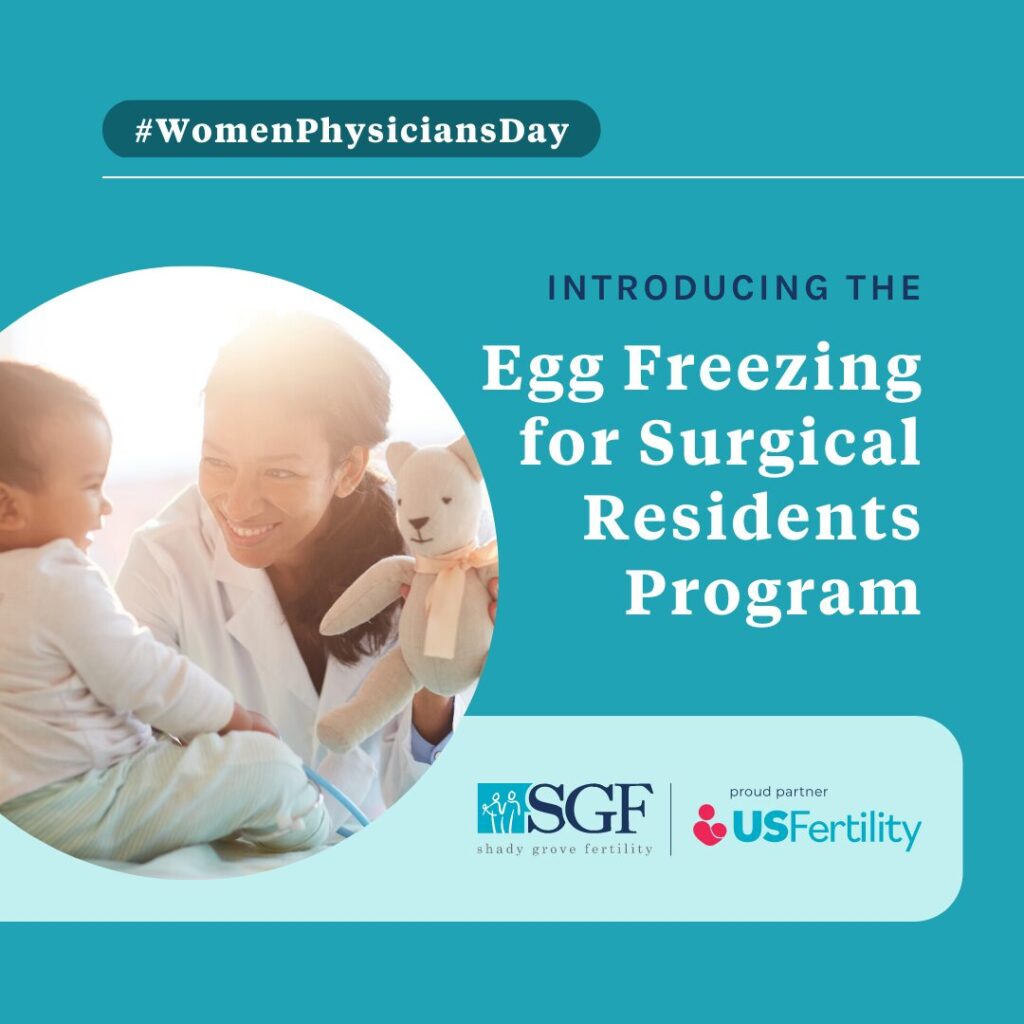
AMWA was honored to partner with Shady Grove Fertility (U.S. Fertility) in the announcement of their Egg Freezing for Surgical Residents Program.
Access to the Egg Freezing for Surgical Residents Program will help extend family-planning options to a group of women in medicine who might otherwise not be able to pursue egg freezing. AMWA hopes that more programs like this will become available to women physicians and commends Shady Grove Fertility for its commitment to and support of women in medicine.
Stories matter. Read about Dr. Erica Kaye’s incredible journey “With infertility, it took nearly 900 needles to bring my son into the world.” Share your stories on the AMWA blog or other platforms to raise awareness of the importance of this issue.
In 2025, AMWA partnered with researchers at Teachers College on a study of reproductive life stories.
In 2022, AMWA partnered with researchers at Northwestern University on a study of women physicians and childbearing, infertility and career trajectories.
In 2021, AMWA’s Physician Fertility Working Group launched the SPACE (Study of Physicians And Children: Expectations and Experiences) study to better understand the impact of infertility on physicians. A series of articles from analysis of this data have been published: