
Authors: Rhea Manohar, MPH; Bethany Fenton, MS; Yun Weisholtz, MD-PhD on behalf of AMWA Gender Equity Task Force
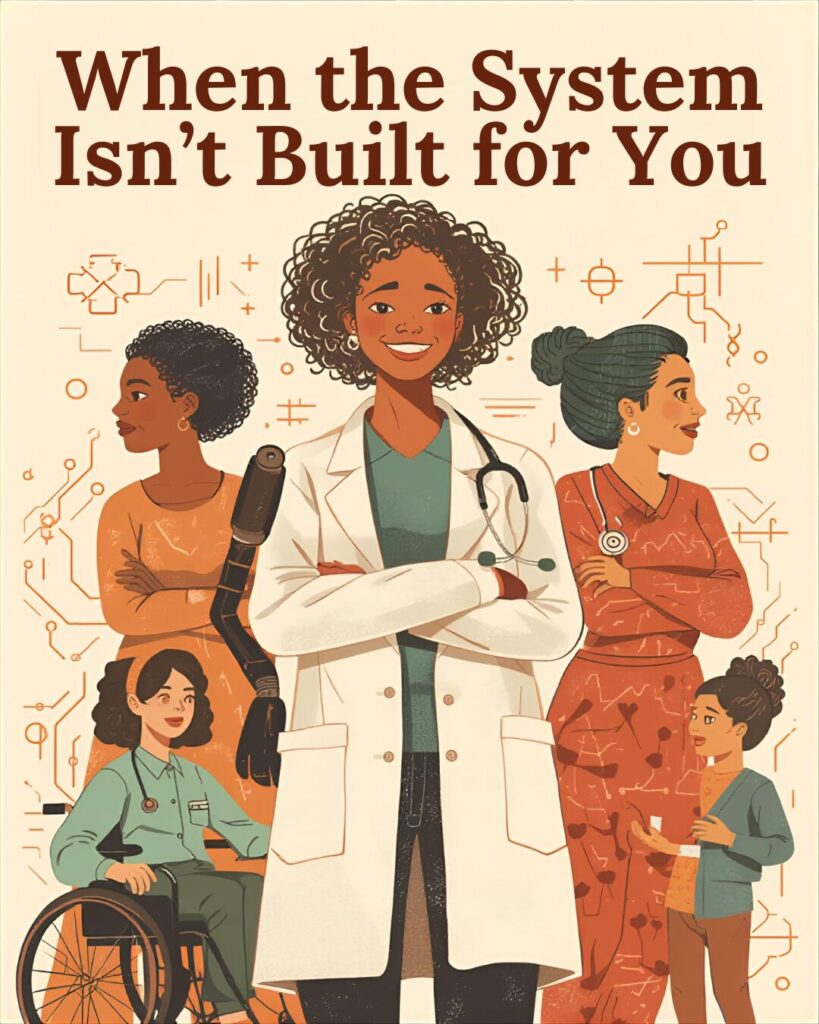
Disability and gender have long been treated as separate axes of inequity in medicine. Still, their intersection tells a more complex story defined by compounding barriers, systemic bias, and profound resilience. Women with disabilities, whether as patients or as physicians, face distinct challenges that reveal the structural ableism and gender inequities embedded within healthcare systems. As we strive towards bridging inequities, shedding light on the intersection of gender and disabilities is an opportunity to strive towards greater inclusivity for patients and physicians alike. For clinicians, understanding these dynamics is essential not only for equitable care but also for cultivating safer, more supportive professional environments, with direct implications for patient outcomes, team dynamics, and professional well-being.
Although approximately 3–4% of U.S. physicians report a disability, those who experience discrimination are more likely to identify as a member of other marginalized groups (Nouri et al., 2021). While medicine has made strides in addressing gender inequity, disability inclusion lags far behind. The culture of medicine is built on ideals of endurance, perfection, and “able-bodiedness,” but that can make disclosure risky. Physicians with mobility, sensory, or chronic health conditions frequently report fear of stigmatization or being mistreated if they disclose a disability to leadership or colleagues (Iezzoni, 2024; Pereira-Lima et al., 2023). In a study of 173 first-year resident physicians with disabilities, 50.6% did not request needed accommodations; among them, 59.5% cited fear of stigma or bias as a significant reason (Pereira-Lima et al., 2023).
For women physicians, this fear is compounded by gender bias. In surgical and procedural specialties, the barriers intensify: limited adaptive technology, inadequate physical accessibility, and a persistent “hero” mentality that equates physical stamina with professional worth (Mesiti & Yeo, 2023). The result is talented clinicians leaving medicine, not because of a lack of capability, but because of a lack of institutional imagination. These biases and limitations may be more pronounced in those women who also experience disabilities.
On the patient side, women with disabilities face disparities that ripple across nearly every health outcome. They are less likely to receive preventive screenings such as mammograms, Pap tests, or reproductive health services within the recommended guidelines (CDC, 2024). The consequences are measurable. According to the CDC, women with disabilities experience greater disparities in healthcare access, including gestational diabetes, obesity, and chronic hypertension. This may be due to their concerns being dismissed, inadequate health insurance, or a lack of accessible exam equipment, which prevents appropriate screening (CDC, 2023; CDC, 2024). The intersection of gender bias and ableism creates a double bind that undermines trust in the healthcare system.
Addressing the intersection of disability and gender in medicine requires shifting from an accommodation mindset to an inclusion mindset. An accommodation mindset is reactive, responding to individual requests for support. In contrast, an inclusion mindset is proactive, embedding diversity and accessibility into the fabric of medical practice as the norm rather than the exception. Even the physical spaces of care tell the story: inaccessible exam tables, narrow doorways, unaccommodating imaging equipment, or rushed appointments that fail to account for communication or mobility needs. These are not isolated oversights, but are reflections of a system designed without disabled bodies in mind.
For patients, improving care begins with embedding disability competency into medical education. Medical students receive varied training in disability competency, with a 2023 study showing that half of the medical schools interviewed had a total of 1 or 2 learning activities related to disabilities, ranging from 45 minutes to 2 hours (Lee et al., 2023). This lack of preparation contributes to implicit bias and clinical discomfort, both of which directly affect care quality. Medical schools should integrate longitudinal learning activities into existing curricula and training programmes, including lectures, panels, and ongoing dialogue on disability, to help future physicians reduce both implicit and explicit bias.
The intersection of gender and disability in medicine is not a niche issue, but rather a lens that reveals how inequitable our systems truly are. Equity for women with disabilities, whether physicians or patients, requires structural accountability, not just empathy. True inclusion in medicine does not mean making room for women and disabled individuals at the table; it means redesigning the table itself.
References:
- Centers for Disease Control and Prevention. (2023). Disability and women’s health. Retrieved from https://www.cdc.gov/women/disabilities
- Centers for Disease Control and Prevention. (2024, July 19). Supporting women with disabilities to Achieve Optimal Health. https://www.cdc.gov/womens-health/features/women-disabilities.html
- Iezzoni, L. I. (2024, August 28). Ableism and Structural Ableism in Health Care Workplaces. JAMA Network. https://jamanetwork.com/journals/jamanetworkopen/fullarticle/2822913
- Jain N. R. (2024). Legibility: knowing disability in medical education inclusion. Advances in health sciences education : theory and practice, 29(2), 507–530. https://doi.org/10.1007/s10459-023-10268-1
- Lee, D., Pollack, S. W., Mroz, T., Frogner, B. K., & Skillman, S. M. (2023). Disability competency training in medical education. Medical education online, 28(1), 2207773. https://doi.org/10.1080/10872981.2023.2207773
- Meeks, L. M., & Moreland, C. (2021). How should we build disability‑inclusive medical school admissions? AMA Journal of Ethics, 23(12), E987–E994. https://doi.org/10.1001/amajethics.2021.987
- Mesiti, A., & Yeo, H. (2023). Surgical device design: do instruments fit today’s surgeons? BMJ Surgery, Interventions, & Health Technologies, 1, e000159. https://doi.org/10.1136/bmjsit-2022-000159
- Nouri, Z., Dill, M. J., Conrad, S. S., Moreland, C. J., & Meeks, L. M. (2021). Estimated prevalence of physicians with disabilities in the United States. JAMA Network Open, 4(3), e211254. https://doi.org/10.1001/jamanetworkopen.2021.1254
- Pereira-Lima, K., Meeks, L. M., & Ross, K. E. T. (2023, May 11). Barriers to disclosure of disability and request for accommodations among first-year resident physicians in the US | medical education | jama network open | jama network. JAMA Network. https://jamanetwork.com/journals/jamanetworkopen/fullarticle/2804787
About the Authors
Rhea Manohar, MPH, MS3

Rhea Manohar is a third year medical student from St. George’s University. She has a Masters in Public Health with a concentration in Maternal and Child Health from George Washington University Milken Institute of Public Health and a Bachelors of Science in Microbiology, Immunology, and Public Health from the University of Miami. She served as Co-VP of OB/GYN Education for St. George’s University’s Women in Medicine chapter in St. George, Grenada where she developed and implemented hands-on workshops to further reproductive health issues and bolstered medical students abilities to navigate physician-patient communication. Prior to medical school, she was a Research Associate for Fors Marsh Group, where she led qualitative and quantitative public health research and campaign development for federal agencies (e.g., CDC, NIH, DHHS, CPSC). She is also a member of the Gender Equity Task Force and Reproductive Health Coalition within the American Medical Women’s Association. When she is not pursuing medicine, you can find her reading, exploring artistic passions, and spending time connecting with friends and family.
Bethany Fenton, MS4
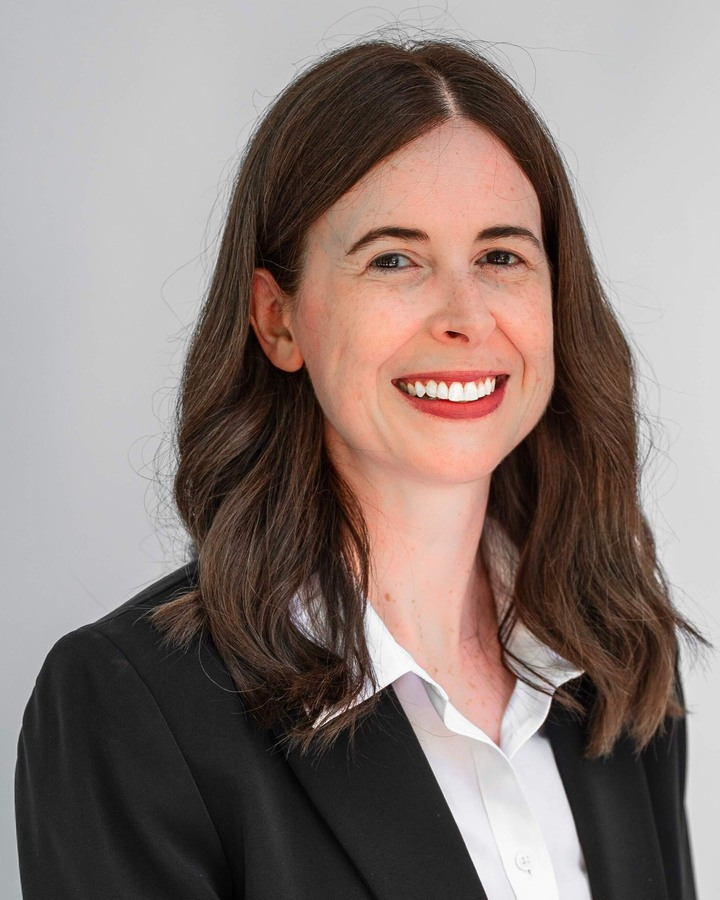
Bethany Fenton is a fourth year medical student from St. George’s University. She holds a Master of Science in Nutritional Sciences from the University of Kentucky and received a Bachelor of Science in Dietetics from Eastern Kentucky University. She worked as a critical care dietitian for ten years prior to pursuing medical school. She is also a member of the Gender Equity Task Force and Nutrition and Medicine Working Group Committees within the American Medical Women’s Association. When she’s not studying, you can find her spending time with her husband and cats, using her Holga camera for experimental photography, lifting weights at the gym, playing board games, and reading science fiction novels.
Dr. Yun Weisholtz is a physician-scientist and advisor with a deep commitment to mentorship and advancing equity in medicine. She completed her undergraduate studies at Stanford University, where she double-majored in Biological Sciences and Chemistry, and spent a year in Germany as a Fulbright Scholar. She went on to enter the MD-PhD program in Neuroscience at Harvard Medical School and MIT, where she developed her passion for research, teaching, and mentoring. Dr. Weisholtz is a Physician Advisor with MedSchoolCoach and the founder of MD-PhD Advising, a consulting practice dedicated to helping students navigate the medical school and residency application process. Outside of work, she enjoys collecting Delft pottery from the Netherlands and spending time with her family and pets.