
Authors: Meghan Etsey, Aida Mansour, Leah Liszak on behalf of AMWA Gender Equity Task Force

“Our Voices, Our Future” is a podcast by the Gender Equity Task Force of the American Medical Women’s Association that explores the challenges, stories, and successes of those working to advance gender equity in medicine. Through candid conversations with changemakers, advocates, and leaders, each episode dives into issues like pay gaps, leadership disparities, and inclusive workplace culture. Tune in to be inspired, informed, and empowered to take action. Full episode listening links are available below the transcription.
Meghan Etsey: Welcome to Our Voices, Our Future, the podcast where we amplify the voices driving change and equity within medicine and beyond. Brought to you by the Gender Equity Task Force, a committee of the American Medical Women’s Association. We’re here to challenge norms, break barriers, and ignite conversations that matter. I’m Meghan Etsey, and in each episode, we’ll bring you candid discussions with leaders, change makers, and advocates working to create a more inclusive and just world. No more silence, no more waiting. You’re listening to Our Voices, Our Future. Let’s get into it.
Today, I have the absolute pleasure of welcoming one of my best friends from medical school, Aida Mansour. Aida is a fourth-year medical student at St. George’s University School of Medicine with a deep passion for neurology and a dedication to making medicine more human-centered and accessible for all. Aida has a bachelor’s degree in biomedical sciences from the University of Guelph. Through her platform, Dr. Mansour in the Making, Aida shares an authentic glimpse of life as a medical student, celebrating both the challenges and the triumphs of her journey. Her transparency and positivity have inspired countless future physicians to pursue medicine with resilience, curiosity, and compassion. Beyond her academic and clinical accomplishments, Aida brings empathy, creativity, and joy into every space she’s in.
Please join me in welcoming my dear friend and colleague, Aida. Thanks for being here.
Aida Mansour: Thank you for having me. I’m blushing!! Oh my goodness. What an introduction.
Meghan Etsey: So, before we kind of dive in, can you tell us a little bit more about yourself? What drew you to medicine? What these last four years have taught you, or three and a half, you’re almost done, about becoming a future physician?
Aida Mansour: Yeah, for sure. First of all, thank you for having me again. So a little about myself. I was originally born and raised in Ontario, Canada. So go north. I went to, as you said before, I went to the undergrad at University of Guelph, where I majored in biomedical sciences with a minor in family and child studies. And it’s cliché, I know, but from a young age, I kind of always knew I wanted to be a doctor. I would walk around my house with this plastic red briefcase that was all, all messed up with this yellow plastic stethoscope, checking on everyone in my family. And as I grew up and actually studied science, I found a deeper connection to it. And I became more fascinated in what the human body was and how deeply intricate everything was tied together. So from a young age, it really always did feel like it was my purpose, especially like because it meant helping people. And so falling in love with the science of it and with the people aspect of it, it just made sense.
And throughout my four years in medicine, oh my goodness, I’ve learned so much about myself, so much. I feel like I’ve transformed into such a different person in all, hopefully all the good ways. Number one, just like how much stress and pressure I could take. I never thought like if you told me when I was younger, I could do any of this, and like every year it got harder and every year we did it, so that was just crazy to see, like oh wow, like I do have this perseverance. I do have this ability to adapt to new environments, taking all of these different tests. Like, it was just, I don’t know, it proved a lot about what I could do and what I could handle.
Yeah, I just, I learned a lot. I learned how to adapt in new environments with clinicals, how to change with every hospital, and like just feeling out different environments and residents. And I feel like medicine is really just about adapting. And it’s in all the aspects, academically, clinically, everything.
Meghan Etsey: I feel like that’s something, as people who mentor people who are going into medicine or going into clinicals, it’s something you can’t explain—how much you change and adapt to be a medical student. Like, I’ve become, I always say like I’m a completely different person than I was in undergrad.
Aida Mannsour: Yeah, it’s crazy.
Meghan Etsey: If I was me now in undergrad, it was over for the MCAT. It was over for Ivy League school. I was going there because I… am that caliber now, you know, but never ever was I that before. So it’s so cool how we kind of get to see ourselves transform in medical school. And it’s so great, it’s incredible.
So, talking about kind of transitioning into clinical rotations. How was it as an aspect of being a female medical student? Were there any things that surprised you? Were there any like juicy things that happened that we kind of talk about, the cliche things that don’t actually happen? Like, how was that?
Aida Mansour: Oh, for sure. So like going into clinical rotations was extremely nerve-wracking for many reasons. Number one, I had just moved to another new country. So I was in America for the first time. And although they are very similar in a lot of ways, it’s still a culture shock, especially on the East Coast. People are a little bit more harsh. So my little Canadian self wasn’t used to that. But in terms of like the hospitals and what to expect, it was just like, we kind of just got thrown in. So it was scary, but I think, like on the island, I found the SGU students, and that gave me like peace. Like seeing people who like, I didn’t even know, but just them saying, “oh, we’re SGU”. Like it kind of felt like home in a way. And-and the older students are always so helpful and giving advice. And that’s something I always appreciated about our school.
Like, People talk a lot of, a lot of things about our school, but one thing that I always appreciated was like we’re always willing to help those always like above us, below us, anything. Like, if they needed help, we’re there, we’re gonna give you advice, we want to see you win, and you don’t get that in a lot of medical students. You always hear the cut-throat stereotypes and everything like that. And I don’t know, with SGU students, I haven’t seen it too much. It definitely exists, but I’ve always gotten the help and assistance, and that that made the transition a lot better.
In terms of like being a female student, I honestly didn’t feel it like in the first half of third year. Like, I was surrounded by female residents, female med students, female attendings. So I was like, “Oh, like this is so great”. Where I started to feel that difference was in surgery. And we’ll definitely get into that after. But just, I realized all the attendings were male. And it’s just like, I don’t know, I just noticed that difference. Even if it was like a quiet one, there was like microaggressions. There were a lot less females. There was like more comments on your appearance than there were the male colleagues, so it’s things like that.
Meghan Etsey: Interesting, I’ve never really thought about the comments on appearance, but when I spent an evening at the ICU one night, and one of the male residents, like I had my hair back in a clip, but it was like in a ponytail type, and he was like, “why would you come to clinicals with your hair like that?” Like “that’s not appropriate”. Like it needed to be tied back more. I wasn’t even doing anything. Like if it was like I was in a sterile field or whatever, like I would wrap it up more. But I literally was just like shadowing and walking around and watching them talk to patients. So it’s very interesting. I haven’t really thought about how like people comment on the appearance of how you show up.
Do you feel that being a woman in medicine has come with these certain expectations, whether it’s like how we communicate, show our emotions, or like how we lead our way throughout rounds and on the wards?
Aida Mansour: 100%. Like, I think broadly, yes. And then on top of that, obviously, you know me, I’m super outspoken and emotional. And like, you just can’t do that, like in medicine, and especially as a med student. Like, you’re not there, you don’t have like the MD, you don’t have the attending status to kind of like have an opinion, like. And that’s just the truth of it. We want to believe we’re equal and we’re just not. Like, there still is very much so that hierarchy in medicine, and you have to know your place. And women already get this title of being too emotional and too attached, and too invested. So I definitely was aware of that. I definitely was aware of who I was with when I was saying certain things.
And yeah, and going back to the surgery rotation, I- it was so clear the gender roles. Like, for example, I had I- was like the best in the suture practice. Like, I was doing it da da da, and the surgeon who was teaching us was like, You have to ask to close and all this stuff, and they’ll let you do it. There were so many times I asked to close in surgery, and I was just told “no”. Um, there was this one time I talked about on my Instagram where I was shadowing an anesthesiologist, and I walked in and introduced myself to him, and he’s like, “Please don’t tell me you’re a med student. I hate med students”, with all seriousness. And I was just like, “Haha, what do I say to this? Like, what am I supposed to say?” And then I asked if like they they were having trouble putting in an IV, and I asked if I could like help them. And they were like, “Are you”… he was like, “Are you even allowed to touch patients?”
Meghan Etsey: Oh…my…Gosh.
Aida Mansour: And it was just like, yeah, it was just like, I kind of just laughed it off and played along because it was so awkward. And I’m like, “yeah, we are allowed to touch patients”, believe it or not.
And on the flip side, my male colleague, who wasn’t like, I don’t know, I don’t want to talk about competencies. But like, but just like this guy, he would just talk to surgeons about things like golf or football or like lifting. And the first surgery he was ever in, he closed all the suture ports.
Meghan Etsey: Oh my gosh.
Aida Mansour: He just got all of these opportunities, and like would be invited to hang out with the guy surgeons outside of work. And it was just like that’s when I started to see the difference.
Meghan Etsey: That is so wild to me. What is the wildest thing that I will never understand is these, these doctors, this anesthesiologist that looked at you and said, “Are you allowed to touch patients?”, was a med student before, right?
Aida Mansour: They know, like!
Meghan Etsey: Like, why are we doing this?
Aida Mansour: Exactly. If we were in a different field and you didn’t get what we went through, it would make sense, but you were literally here.
Meghan Etsey: Yeah. Let’s make it better for the future.
Aida Mansour: Exactly. And you know what’s interesting, I was with a female anesthesiologist the next day, and she let me like hold the mask intubation. And like it was just that difference when I started to see, oh, there is still this disparity. And I think it makes sense because surgery is still a very male-dominated field. But yeah, that’s definitely where I noticed it the most. And I would get frustrated because, as a female, and I feel like you could relate to this too, we try to impress everyone with our knowledge. We have to know the most and know the procedure in and out. And we’re ready to get pimped and ask these academic questions. But all you had to do is talk about football, and that would get you in.
Meghan Etsey: Yeah, right. Like, I didn’t need to show up and know the anatomy of this whole surgery. If I knew their favorite quarterback and could talk to them about that, we would be good. Oh my gosh, yeah, we have got to do better. We got to do better. Even if it is male-dominated, the complexes are just… It’s just so weird to me.
Aida Mansour: Yeah, it is.
Meghan Etsey: Um, can you share a time, like on the counter, when you have felt more empowered or supported as a woman in the clinical setting, and then maybe if you have another story of when you felt dismissed or underestimated in what you’ve been doing?
Aida Mansour: Yeah, uh, for sure. I felt like empowered, I think the most during my internal medicine um rotation, and there was this one time in particular where we had a week of like rounds with a team, and I just kind of looked around. And the attending was female, and the residents were all female, and it was all female med students. So it was like literally an all-female team, and I was just kind of like, I had this like, wow, we did it. We got into a space that was not allowed for us, that we weren’t supposed to be in, that everyone told us like “medicine isn’t for women”, or women who want families, or stuff like that. And all of these people had those things, and it was just very like full circle. I remember taking a selfie with them, like, “guys, we made it, we did it”. Yeah.
Meghan Etsey: I love that.
Aida Mansour: In terms of another time… oh, I have stories for days. I think, I think like one of the huge shocks was OBGYN because it’s, it’s SUPER LIKE women-forward, that you’d expect the complete opposite.
Meghan Etsey: Mhmm.
Aida Mansour: But it was just SO hostile. And I know, like before I did this rotation, everyone told me the stereotypes, like, and I’m like, “all right guys, it can’t be that bad”. Like “I think we’re just hating on women”. No, no, no, no. At least where I went, they were telling the truth. Um, the first day we got there, the first day we like introduced ourselves, whatever, the midwife turned to her colleague and was like, “Oh great, now we’re gonna have teenagers seeing our patients”. And it’s like, Miss Ma’am, like we’re gonna be doctors next year.
Meghan Etsey: Yeahhhh. I- It’s so interesting, the female-to-female dynamic. Like, we recognize these things, and we know that we are put down in these settings, but then there’s like still a complex between us.
I was getting interviewed last week by a residency program, and the guy, the assistant program director who was interviewing me had read about my woman in medicine work, and he was like, “I have a very interesting question for you. As a man, I have seen that like women nurses and women doctors they’re, they are mean to each other”. Like, “Why do you think that is?” And honestly, I truly believe it’s because like society has put us in this position where we are in like a fight-or-flight mode, and we think that we have to like not only like prove ourselves to men but anybody that we see as in a position of power.
Aida Mansour: Exactly.
Meghan Etsey: We think we have to compensate for that. So I feel like in these situations, where a midwife was like, “Oh great, now we have teenagers taking care of our patients”, it’s probably because they feel threatened a little bit, ya know?
Aida Mansour: 100%.
Meghan Etsey: It’s so weird. Like, why do we have to feel threatened by each other? Why can’t we just have space for everyone?
Aida Mansour: Right! Yeah. Right. And you know what was so interesting with that rotation, too, is like we had like two male attendings, and the nurses would eat them up. Like, they would make so much conversation and ha-ha and laugh. And I and I was like, okay, the energy was completely different with the female attendings. They wouldn’t talk to them. They wouldn’t speak to them. There was no like uh cordial or casual conversation. Like, all of us were like, are we seeing this? Like, this is odd.
Meghan Etsey: Yeah.Yeah. It’s very interesting.
Aida Mansour: I think it’s so strange.
Meghan Etsey: Yeah. It’s so sad. It’s so.. I feel like it could be so much better. And I don’t blame any woman for it. I think that it’s really how society has set us up to be defensive for ourselves.
Aida Mansour: Right, right.
Meghan Etsey: Can you talk a little bit about mentorship, especially maybe any other women who have influenced you or your experience, and how you think that still, in some ways, mentorship falls short for female medical students?
Aida Mansour: Yeah, I like…you know me, I think mentorship in general is like SUCH a powerful tool in medicine. I think if you take that out, I think the whole thing would crumble. Because it’s, it’s a long and grueling journey. And as like grateful as we are to be here, like it’s tough. And that’s just what it is. And so, without people guiding you, without people supporting you, it just becomes so much more difficult. And having those, like, I’ve talked about this before, those upperclassmen, and people in the same year, like you—I would consider you one of my mentors. Like, I look up to you and how much you’ve done, and I’m like, wow, we can do these things. We can, we can be part of clubs, and be successful, and have a family, and have a love life, and all these things, and still be successful, especially seeing women do that in medicine, which is something we were told like “you have to sacrifice one or the other to do it”.
Meghan Etsey: Yeah.
Aida Mansour: I think that’s so powerful to see.
And, and the people who have always kinda given me advice are always women. Like when I was reading this, when I was reading this like prompt, I was like, ya know, I realized that when I talk about mentorship, it’s usually always women that offer their assistance and their advice.
Meghan Etsey: Yeah. That’s like a real thing. We’re actually writing a blog on that right now about how women are more like um socially and emotionally extended because they are the ones that assume these roles.
Aida Mansour: Absolutely.
Meghan Etsey: And nobody says that like guys can’t, men can’t mentor me as well. I’ve had like a man mentor in my life, and he was incredible, but I think that’s just not really part of the social norm usually, right?
Aida Mansour: Right.
Meghan Etsey: But it doesn’t have to be like that.
You talked a little bit about some microaggressions that you’ve heard. Can you tell-like how do you handle that, like whether they came from your peers, patients, staff, and like what have those experiences taught you about how you need to be with yourself and resilience in medicine?
Aida Mansour: Yeah, I think we like touched on it a little bit. For sure, of like also knowing your role as a medical student. Like you will get mean nurses, mean doctors, mean patients. Like that is just- That just comes with the territory of clinicals and being in the field. And as a medical student, I think you just got to swallow it. And-and like I said before, you know me, you know how hard that is. You know, I’m very like, “don’t put up with anything”. But I think this field specifically taught me so much that, like you just got to just let it roll off your back. You gotta smile, listen to what they say, okay, and that’s it. Just don’t say anything about it. Vent to your friends at home, vent to someone else, but in the hospital, in the professional setting, unfortunately, there’s not much you can do.
Meghan Etsey: What do you think about like in the future? Does that like propel you, to like as a future, and somebody who will be in a position of power in the future, does that motivate you to make some change later though?
Aida Mansour: For sure, for sure. Like being an open space to actually let these students tell you if something’s wrong, and being able to be in a position of power to correct it. Absolutely. That’s something I would want to do. I think like one, one moment that kind of just popped into my head is again in surgery. When we had one of the residents who was like just giving us so much microaggressions, and kind of just aggressions period about being Caribbean med students.
Meghan Etsey: mmmm…
Aida Mansour: And we felt like so alienated. And we’re like “we’re doing everything that you’re asking us to do, and you’re like still calling us out in the group chat, and like uh, like singling Caribbean students versus the Rutgers students that were also with us”.
Meghan Etsey: mmmm…
Aida Mansour: And in that moment, like we had a really good like leader, like the uh what are they called, like the student coordinator, who was like, “hey, if there’s anything, like come to us. Come to us. Come to us.” So we were all like “oh, we can come to you and like talk about it”. And we did, and nothing came out of it. Like, so, so it’s hard, because what can you do also in that position? Like, they went and talked to them and tried to like make sure they understood our requirements and stuff, but that kind of doesn’t change the fact that they’re going to treat you how they want to treat you. And that’s what’s tough. And I think it comes, like the real issue, the real thing that needs to be addressed is the culture of the program and who you pick. And like you’re in interview season, and I’ve heard program directors say “we want someone who is going to work well as a team” because like medicine is very much a team sport. And obviously, you’re going to get those people who don’t do that. But I think now more than ever, programs are realizing the culture of their program matters. It matters how they’re going to treat patients, staff, nursing, med students. So I think that’s the real root issue is: picking the right people.
Meghan Etsey: Yeah. Yeah, I love it. Um, so having gone through medical school together, what role do you think like friendship and solidarity between women, like not only like me and my mentors, but like us together, um work in surviving through this? Surviving, thriving, getting through this crazy journey that we’re going through?
Aida Mansour: 100%. Like, Oh my gosh, friendship like in medicine is huge, huge. Like I tell the like younger students who ask me stuff about going into medicine, I’m like, “No, you need to go and find your people”. That is the, oh my goodness, on the island I would think about it all the time. I’m like, I would not have gotten through this without you guys, like even with, even crying together, studying together, laughing together, even things that weren’t related to medicine. It pushed me so hard. It made me want to be better. It made me just like look at each other and be like, wow, we’re all going to do this, and we’re all going to make it. And we have each other, and that’s like such a beautiful thing.
And things even not related to medicine, like when after exams and we would go out to dinners, and we would go to the beach, and we would go to all of these adventures. Like those are the memories that I will always remember. And I think that’s just crazy that I look at you guys, and I’m like, “dang, my friends are gonna be doctors”.
Meghan Etsey: Yeah oh my gosh, yes. Coming from a community that’s not full of doctors, like to know that all of your people are gonna be doctors is the coolest thing to me. And we’re almost there. Like, it’s still so cool, but we’re almost there as well.
Aida Mansour: It is. It is. And I’m like, great, now I’m gonna have an “IM doctor” that I can call.
Meghan Etsey: A little consult!
Aida Mansour: Exactly. It’s just beautiful. Like friendship is so important. And it’s like, because medicine is not just study, put your head down and you can do it. It’s support. We knew, we knew so many people who were fantastic academically, and they still left because they didn’t have anyone to vent to, to be with, to hang out with. Support is so important, and friendship is so important.
Meghan Etsey: I often reflect on how nobody else in my life understands what we’re going through other than each other.
Aida Mansour: Absolutely.
Meghan Etsey: And on the island, it was so great because we were all together and we had each other’s support like at text. Like, if I texted you, you were coming over, right?
Aida Mansour: Right.
Meghan Etsey: But then we came back to the States, and we all dispersed, and it was never so clear to me like how much I needed that support.
Aida Mansour: Absolutely, 100%. Like I- And it’s funny because we’re like, “oh, we’re going to be in America and everything’s going to be great, and it’s going to be fantastic”. And then it’s like, oh, we have all the things that we wanted, but not being in arm’s length of each other is so lonely. It’s very, very isolating.
Meghan Etsey: Absolutely. So to kind of just close, what advice would you give to younger women entering medicine, to those that might be nervous about the biases, challenges, expectations, all these scary things we’ve been talking about? Um, what’s your advice to encourage them that life is still good and you can get through it?
Aida Mansour: My advice to younger women entering medicine is that you can do it, you just have to block out the noise. Cause you’re gonna hear sooo much noise. You’re gonna hear so many people telling you, like I hear this all the time, like “medicine isn’t for women”. It’s not for people who want families. It’s not for people who want to spend time with their kids. And that’s a scary thing to hear, especially if you are a woman who wants all of those things. But I’m here to tell you, and Meghan is here to tell you as proof, that you can have a love life, you can have a family, and you can still be successful and great at your job. Many of us are just scared of that balance.
And like we talked about before, it’s especially hard being a woman and trying to do that balance. But knowing that you’re gonna be able to provide financial security for you and your family, I think, is like so huge. And that’s something people don’t talk enough about in medicine. Even though you love it, and you should love it first and foremost, that job and financial security for you and the rest of your family is so huge. And to me, I think it’s worth it, especially in today’s society, especially when, like you don’t know where the economy is going, you don’t know where anything is going. Having those, like knowing you’re going to finish this and have a job, that’s huge.
Meghan Etsey: I think a lot of people don’t talk about something that’s come to like fruition for me is..yeah, coming from a background that was not super financially privileged, you have no idea sometimes how you’re going to make it in the future, being like a mom who has like a crazy job. But once you have that sense of financial freedom as well, you understand, like, I can pay a babysitter, and it’s going to be okay.
Aida Mansour: Exactly.
Meghan Etsey: I can order my groceries, and it’s going to be okay.
Aida Mansour: Right.
Meghan Etsey: You can compensate in different ways that aren’t really imaginable until you kind of see that happening in somebody else’s life. I think that’s a great point.
Aida Mansour: Yeah. Exactly. And it’s just knowing that, like, I can be a great doctor, a great mom, a great provider, like all of those things. I think, and loving it, those just make it worth it to me. And I think if you really cannot see yourself doing anything but medicine as a woman or as anyone, do it. Do it. It’s worth the sacrifice.
Meghan Etsey: Thank you, Aida. It’s been a great conversation. It’s been super cool to talk to you today and kind of hear your heart and how your journey has been throughout medical school so far.
So that’s a wrap on this episode of Our Voices, Our Future. We hope today’s conversation inspired you, challenged you, and reminded you of the power of raising your voice. The fight for equity doesn’t stop here. Join us in the movement. Subscribe wherever you get your podcasts. And if you love this episode, share it with someone who needs to hear it. Until next time, stay bold, stay vocal, and keep the conversation going. This is Our Voices, Our Future.
Links to our podcast:
RSS https://rss.com/podcasts/our-voices-our-future/
Apple Podcast https://podcasts.apple.com/podcast/id1805991643
Spotify https://open.spotify.com/show/5E59jvuFQOjSXfLrjQiy0P
Podcast Index https://podcastindex.org/podcast/7278557
Fountain https://fountain.fm/show/7278557
True Fans https://truefans.fm/82727577-2b37-5929-aa2e-1574d478b177
About the Authors
Meghan Etsey, MS4

Meghan Etsey is a fourth year medical student from St. George’s University. She has a Bachelors of Arts in Biology and a Bachelors of Arts in Nutrition and Dietetics from Bluffton University in Bluffton, Ohio. She served as the President of the St. George’s University’s Women in Medicine chapter in St. George, Grenada where she expanded relationships with the community and worked towards educating women and helping the youth. She is also a member of the Gender Equity Task Force and Sex and Gender Health Collaborative Committees within the American Medical Women’s Association. When she is not pursuing medicine, you can find her with her friends and family on different road trips and adventures exploring the world.
Leah Liszak, MS3
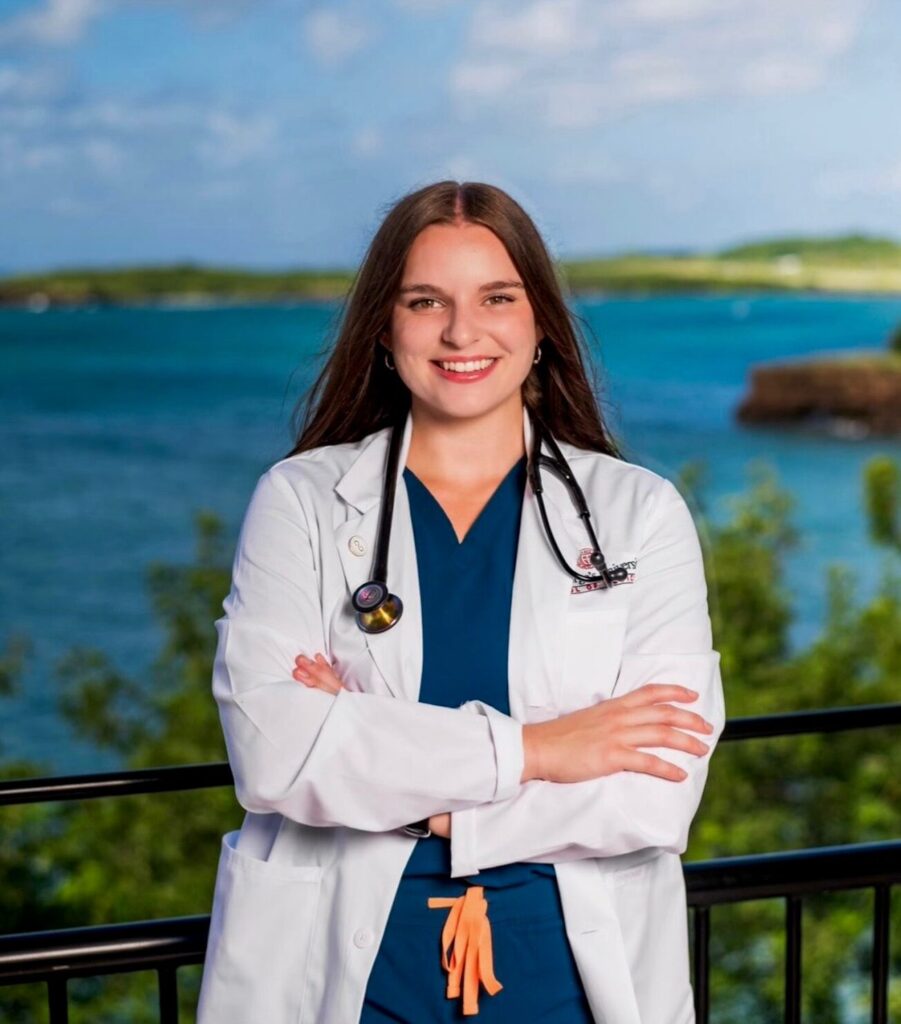
Leah Liszak is a third year medical student from St. George’s University. She has a Bachelors of Science in Biomedical Science from Oakland University in Auburn Hills, Michigan. She served as the SMILEs Orphanage Home Coordinator of the St. George’s University Humanism Service Organization in St. George, Grenada where she fostered impactful relationships with at-risk female youth and developed seminars to educate, encourage, and engage their personal growth. She is also a member of the Gender Equity Task Force with the American Medical Women’s Association. When she is not pursuing medicine, you can find her enjoying time with friends and family, working towards athletic pursuits in the gym, and testing new pastry recipes.