
Authors: Meenu Immaneni, Meghan Etsey, Vashti Price, Beatrice Hyppolite on Behalf of the AMWA Gender Equity Task Force
“Our Voices, Our Future” is a podcast by the Gender Equity Task Force of the American Medical Women’s Association that explores the challenges, stories, and successes of those working to advance gender equity in medicine. Through candid conversations with changemakers, advocates, and leaders, each episode dives into issues like pay gaps, leadership disparities, and inclusive workplace culture. Tune in to be inspired, informed, and empowered to take action. Full episode listening links are available below the transcription.
Meenu: Welcome to Our Voices Our Future, the podcast where we amplify the voices driving change and equity within medicine and beyond. Brought to you by the Gender Equity Task Force, a committee of the American Medical Women’s Association, we’re here to challenge norms, break barriers, and ignite conversations that matter.
I’m Meenu Immaneni, and in each episode, we bring you candid discussions with leaders, change-makers, and advocates working to create a more inclusive and just world. No more silence. No more waiting. You’re listening to Our Voices Our Future. Let’s get into it.
Today, we welcome Beatrice Hyppolite, a public health professional and digital storyteller passionate about making healthcare information more accessible, relatable, and empowering, especially for young professionals. With a background in health education and healthcare marketing, she brings a unique lens that bridges data-driven strategy with lived experience.
By day, Beatrice serves as a marketing program manager at a major hospital system. By night, she’s the creator of The Bea Word, a platform dedicated to navigating post-grad life and public health careers. Whether she’s building campaigns or building community, Beatrice shows up as the online big sister you didn’t know you needed, smart, supportive, and here to help you thrive in and out of the healthcare space.
Welcome, Beatrice. We’re happy to have you.
Beatrice: Thank you. I’m happy to be here.
Meenu: Let’s start from the beginning.
What sparked your interest in public health, and how did that journey evolve into the work you do today, both in your corporate role and through your digital platform?
Beatrice: I would say public health found me before I fully realized what it was. Growing up as a first-generation Haitian American, I witnessed how health wasn’t just about appointments or medications; it was about language barriers, cultural nuance, and the resources people did or didn’t have access to.
That early exposure sparked questions like, Who gets care? Who doesn’t? Why? I didn’t have the vocabulary for public health back then. I didn’t know it was a whole term or field, but I saw the disparities up close and knew I wanted to do something about them.
That curiosity, I would say, grew into a passion during college, where I majored in health sciences, took a class specifically on AIDS, race, and gender, and then later pursued my master’s in public health. I really became interested in health education and health equity.
Understanding that communication is often a huge missing link between information and the people it’s supposed to impact, that’s what led me to healthcare marketing, where I now work on large-scale campaigns that aim to inform and engage diverse communities.
So I would say it’s strategic, super fast-paced, but incredibly rewarding to use storytelling to drive real-world outcomes.
Meenu: I love that. I agree that public health is, I think, everything outside of the clinical part of medicine, because I feel like the clinical part is there, but there’s so much that goes on beyond the clinic room, which plays a big role in health.
Beatrice: Yeah. Exactly what you said. You said it perfectly.
There’s so much outside of just a medical office or the hospital that impacts someone’s life and health, where they live, where they go to school, where they work, and what they eat. Those all have a major impact on their health outcomes as well.
Meenu: Yeah.
You’ve said public health isn’t just data or disease, or like we said, the clinical part of it. It’s deeply cultural, political, and personal. Let’s unpack what that means for you, and what are some everyday spaces where you see public health at play, or even where others might miss it.
Beatrice: Yeah. To me, public health is everywhere. Like I said, it’s in the air we breathe, the food we eat, and the policies that shape our daily lives. But beyond that, it’s also in the culture we consume and the stories we share.
Public health doesn’t live in a vacuum, our identities, histories, and social environments shape it. That’s why it’s so important to approach it not just from a scientific or clinical lens, but from a human one.
For example, how a community responds to a vaccine campaign might have less to do with the science behind it and more with their history with the healthcare system. Or think about how a neighborhood’s design, like whether there are sidewalks or grocery stores nearby, impacts physical activity and nutrition.
These are public health decisions that don’t always look like public health on the surface, but they shape health outcomes every day. Even something like workplace culture is a public health issue. If your job glorifies burnout or doesn’t support mental health, that’s going to show up in people’s bodies and in their everyday lives.
When I say public health is personal, I mean that it touches all of us, whether we recognize it or not. Once you start looking for it, you really see it everywhere.
Meenu: I feel like that’s something people don’t think about. I feel like when people hear about public health, a lot of times, it’s like the pandemic or policy is where people just tend to go. I feel like that is sometimes just, and I feel like I’m glad the pandemic brought light to what public health can do and does, but I also feel like it’s limited the scope of what that really is.
What are some areas where public health issues are overlooked that you’re passionate about and want to bring more attention to, and why?
Beatrice: Yeah, so somewhat related to the work that I do, one I’m specifically really passionate about is digital well-being. We live in a world where most people are online every day, every night, and yet we rarely talk about how our digital lives impact our mental, physical, and emotional health. From algorithm-driven misinformation to the rise of burnout from always being on or just online, we’re seeing real health consequences that need public health solutions.
Another one that’s near and dear to my heart, which I feel like is still overlooked despite the amount of media surrounding it right now, is reproductive justice. It’s not just about access to care, but access to quality care that’s culturally competent, safe, and affirming. Black women in particular face disproportionately high maternal mortality rates.
And that’s not just a medical issue, it’s a systemic public health crisis. We definitely need way more voices pushing for equity in how reproductive health services are delivered and discussed.
And the last one I’ll discuss, which I touched on a little bit earlier, is workplace wellness, especially for early-career professionals. I feel like that doesn’t get enough attention. There’s so much pressure to overwork, to prove yourself, especially at the beginning of your career—to keep grinding. But that comes at a cost, right?
Creating environments where people can thrive without sacrificing well-being should definitely be a public health priority. That’s why I talk a lot about boundaries, rest, and community care in my content, because it’s all connected.
Meenu: I think those are all very relevant to people worldwide and in our country, particularly young professionals. I feel like our culture is changing in how we view being professional and how much we work in setting boundaries, but it’s still there.
The world we step into usually tends to make us work until we’ve reached our limits instead of setting limits. For example, “Oh, this is where I need to prioritize family. I need to prioritize doing something that’s for my wellness. I fully understand how those are all different issues that I feel don’t get as much attention as they need to.
Are there ways that you have started? I think your platform is a big way for you to help address these things and bring them to light. Are there other ways you would want to share about how people can, I think, bring light to the workplace, like wellness issues, like everyday people?
Beatrice: Yeah, I just feel like talking about it, bringing more attention to it, having those conversations more candidly definitely helps. I love that. I feel like after 2020, we saw a lot more Gen Z and Gen Alpha transitioning into the workplace, and that was a huge transition for them, especially the last few years, when they were doing everything remotely. Seeing that as funny as that was, it was still very relatable.
It definitely resonated with me. I was one of those people transitioning into the workplace for the first time. It was definitely eye-opening. No one tells you these things. You just do something for many years, which is going to school, and you get used to that type of schedule. Then you have to change your schedule. It’s completely different than what you’re used to. It’s completely different from what you’ve been told. It’s completely different from what you see on TV.
Just talk about it and be candid so that other people in your community know they’re not alone. I think that’s definitely one of the greatest steps to take.
Meenu: Lovely. You’ve mentioned how public health intersects with culture and even pop culture.
Can you share an example of where you’ve seen health conversations show up in unexpected places like media, music, or fashion, and why those moments are so important?
Beatrice: Yeah, sure. One moment that stands out is how artists like Lizzo have used their platforms to talk about body image and mental health. She’s not a public health professional at all. Still, the way she talks about self-love, therapy, and body acceptance definitely has a major impact, especially for people who haven’t seen themselves represented in those conversations before.
That’s public health in action, basically. It’s meeting people where they are, through mediums they already trust, such as social media, and making it enjoyable.
I also think fashion and beauty spaces have become unexpected but powerful areas for public health dialogue. For example, there are conversations about natural hair and scalp health, or even discussions about skincare and SPF use in Black communities.
Again, since the pandemic, the rise of that has pushed wellness narratives in culturally relevant and more community-informed ways. These moments might not seem academic or clinical, but they definitely reach people where policy might not.
So these pop culture intersections matter because they normalize important topics and expand who feels invited into that conversation. When health becomes part of the culture of conversation, it stops being intimidating, it stops being super clinical, and it starts being a lot more empowering, and that’s exactly what we need if we want more people to engage and take ownership of their health.
Meenu: I love that. I think empowerment should be the focus because it lets people take charge of their world, and I think that’s great.
For example, when you’re talking about fashion, I think beauty comes to mind. I love some of the makeup brands nowadays, like how the numbering for skin and foundation starts at the darker shades instead of the lighter ones. I love seeing that, where you’re building up in variety and range, even in the last decade we’ve seen.
I’m just like, because there are tones, tones to skin, and tones to everything, but I feel like there wasn’t much representation for many people of color for a long time.
You wear multiple hats as a marketing professional and a digital storyteller. How do you navigate both those worlds? Are they different in how you’re navigating both those worlds? How do each of these experiences shape who you are today, and how do you communicate about public health?
Beatrice: Yeah, it’s a balancing act, but both roles feed into each other. In my nine-to-five as a marketing manager, I’m focused on strategy, audience targeting, and measurable impact. I work with cross-functional teams to deliver campaigns that improve patient experience and health outcomes.
It’s super data-driven and structured, but there’s a little bit of room for me to be creative. I’ve learned how to tailor messages to specific communities, a skill that translates directly into my digital content.
On the flip side, The Bea Word gives me a lot more freedom to be personal and candid, as well as myself. I don’t need formal approval from anyone to talk about the things I want to talk about—things like burnout, imposter syndrome, or just the realities of being a young Black woman in healthcare. I can speak in my own voice. I can experiment with different formats. I can make a reel, a carousel, and a blog post. I can be really candid. I can curse if I want to.
Meenu: It’s versatile.
Beatrice: Yes. Yeah. That flexibility definitely allows you to connect with people on a much more human level outside of traditional frameworks. I definitely appreciate that. I appreciate both because I love the structure. I love the opportunity to do that every day, but I also love opportunities to be more myself and let my creative side show.
What I’ve realized in public health communication is that it’s at its best when it’s both clear and culturally grounded. Whether I’m creating content for a hospital or an Instagram story for myself and my friends, I just try to center clarity, community, and compassion because my goal is always to make the message land and not just look good.
Meenu: It’s about messaging as much as how the message is in the picture.
Beatrice: Yes..
Meenu: I don’t think those are the best words for saying that. I think you said it really beautifully. I love that.
In terms of social media, I feel like sometimes it’s a double-edged sword when it comes to health information. I feel like it plays a critical role in public health education and in health education in general.
What do you think the role is for digital platforms, and how can they be used more responsibly without misleading people?
Beatrice: Yeah. Social media is one of the most powerful tools we have right now for public health outreach, if we use it responsibly. It allows us to reach people in real time, break down complex topics, and spark conversations that might not happen in more formal settings.
But as you mentioned, with that power comes a responsibility to share accurate, culturally sensitive, and accessible information. And now the stakes are really high, especially when misinformation spreads faster than the facts. One way to navigate this is by making health education as transparent as possible.
It’s okay to say, “This is what we know right now, and it may change.” That’s totally fine. Not even the experts have all the answers. I think that kind of honesty helps build trust with communities that already have a lack of trust in major administrations and agencies. So I think it’s really important to be as transparent as possible and to let your community know that you may not have all the answers, and even if you do, they’re subject to change.
I think it’s also important to collaborate with creators who have cultural capital to speak to their communities authentically. Hiring people who are actually from those communities to speak on behalf of and to those communities is key, because people listen to those they relate to, not just experts in lab coats with multiple degrees behind their names. People want to talk to themselves or versions of themselves.
So personally, I think digital platforms should be used to empower, not to shame or scare anyone. We can talk about health without guilt-tripping people or making it all feel like doom and gloom.
I definitely try to incorporate humor, empathy, and, of course, storytelling, because I think those all go a long way in helping messages resonate. And when used thoughtfully, social media can be a bridge, not a barrier to bettering someone’s health.
Meenu: I love that. You just talked a little bit about how to make content more relatable.
How do you make public health more relatable, and how can others begin to do the same within their own communities or workspaces?
Beatrice: Yeah, so relatable, honest relatability definitely just comes from being real. I don’t try to present public health like it’s this far-off, overly technical field. I don’t try to gatekeep anything. Anyone can be a public health professional; you don’t need a degree to back it up.
I talk about how I experience it in my relationships, my job, and even in my group chats. I think when people see someone who looks like them or who shares similar life experiences talking about public health, it definitely feels a lot less intimidating and a lot more approachable.
One thing that’s helped me is using language that feels like a conversation, not like a lecture. So, do not use overly flowery language; just be simple and straight to the point.
Whether creating a carousel about mental health or a reel about burnout, I try to blend education with empathy. And I’m not afraid to share my experiences because someone out there is going through the same thing I’m going through. I think being vulnerable definitely helps build that connection further.
At the end of the day, public health is rooted in the community, so I always try to lead with that. For anyone looking to make public health more relatable where they are, I’d say start with just listening. What do your people care about? What do you care about? What’s already being talked about? Then build from that.
You don’t need a big platform; I don’t even have one personally. Sometimes the most meaningful change starts with just a small meeting, a small group, a shared post. Keeping it human means the impact will follow afterwards.
Meenu: I think they are real conversations. Just have those, and then slowly the community will find the people, because it’s about them relating to the content or conversation.
Beatrice: Yeah, exactly.
Meenu:
One of your goals is to help people see themselves as public health advocates, even outside traditional spaces. What do you say to someone who wants to get involved but doesn’t come from a clinical or academic background? Where can they start? I think you started talking a little bit about that. Can you expand on it?
Beatrice: Yeah. So as I mentioned before, you definitely don’t need a degree to make a difference. If you care about your community, well-being, and the neighborhood where you grew up, you’re already aligned with public health values.
Advocacy can look like a ton of different things. It can look like organizing a coat drive, helping a neighbor access resources, or using your big or small platform to share credible health information. Public health isn’t limited to professionals in lab coats or in academic settings.
It lives in everyday acts of care and awareness. A great place to start is by paying attention. What issues do you see happening around you and your community? Is there a major food insecurity issue? Is unsafe housing a major issue? Is gentrification a major issue? Are your fellow neighbors being uprooted from the places they’ve known as home their entire lives?
Start asking those questions, talking about them, joining local community boards, and attending town hall meetings, which are super important if you have the time. There are so many things discussed in town hall meetings that, whether it’s because of a lack of time or scheduling, many people aren’t privy to the changes happening in their own neighborhoods. Those changes and discussions are happening in their town hall meeting.
So just volunteering some of your time at your local library, a local non-profit, or even just sharing a resource online can spark a ripple effect. The work doesn’t have to be big to be meaningful.
I also think it’s important to lean into your unique background. Maybe you’re an artist, a teacher, or a content creator like me. All of those skills are super important and really needed. Public health is evolving, changing, and moving with the times, and we need people from all walks of life. Don’t wait to be invited to help reimagine it. Don’t wait to go to school or to read up on certain things. Just show up, ask questions, and take action in ways that feel authentic to you.
Meenu: I really appreciate that thought because I feel like it’s really important, especially for young people to hear. Some spaces can be hard because you feel like you have to wait to be invited. Growing up, you’re often told that you’re stepping into a space that sometimes needs permission.
Beatrice: Yeah.
Meenu: But I feel like it’s okay to ask and step into the space. “Can I get involved?” All they can say is no. But asking that question is your first step in any space.
The community organization or the board meeting is looking for the voices of the people today. So I agree with you that that step is hard to take, especially for young people. But I think if you can muster up the confidence, there’s a world waiting for you to take action and be part of it.
Beatrice: Yeah, no, exactly. And again, I would still consider myself an early-career professional. Even with everything I’ve done, I’m still hesitant to step into certain spaces.
So I am definitely not giving up on that, and I’m also finding the communities that align best with you. You won’t feel hesitant to go into something that aligns perfectly with what you stand for.
Meenu: No, I agree too. I’m also in that young professional space; I agree you’re not alone. Even if people might look like they’re confident, I feel like they’re also practicing confidence. So continue to practice that confidence because that’s important. In any space you’re in, you are welcomed in many spaces.
My next question is going to be about the field of public health. Like we talked about, how it’s evolving and changing, we’ve talked about the need to be vocal about it. You’ve been vocal about widening the lens of what public health is.
In your words, what does the future of public health look like to you? And what are the issues and things we need to make room for in the future?
Beatrice: Yeah. So to me, the future of public health is intersectional, inclusive, and there’s definitely space to be imaginative. It’s not just about solving today’s problems; it’s about completely redesigning systems so that they can support care, dignity, and joy for everyone living in the system. That means expanding our focus outside hospitals and clinics and looking at the full health ecosystem. Housing, climate, tech, culture, and so many more things exist. Public health should definitely be everywhere, and it should work for everyone.
We need to make room for people who have historically been left out of the conversation, that means Black and Brown communities, queer and trans folks, disabled people, immigrants, and the youth. These communities often carry the burden of poor health outcomes but have the fewest seats at the actual decision-making table. And that definitely needs to change.
I do see it changing as well. Many members of these marginalized groups are making their own tables, bringing their own seats, and creating spaces to uplift themselves and their peers. Leaders like doulas, peer educators, creators, and storytellers are already part of the conversation and should be given platforms to further speak to the work that they are doing. I think that’s super important.
I believe the most powerful health solutions come from collaboration, not competition. That means honoring lived experience just as much as credentials and designing programs with the communities involved and not just for them.
So, it is important to make sure multiple voices are included in the conversations that happen when it comes to changing systems. The future I see is one where public health is as much about creativity and care as it is about data, policy, and all of those larger things that impact our lives.
Meenu: I think that’s one of the things I love about public health, that it’s multifaceted. We need everyone to see the multifaceted nature of public health and be a part of it.
If someone listening right now is thinking, I care about these issues, but I don’t know where to start.. What’s one small step they can take today to begin seeing themselves as a public health advocate?
Beatrice: Yes, start. That’s the first step. Just start. After you start, make sure you start small, start local, start with what you care about. Public health advocacy isn’t about having all the answers; as I mentioned, it’s just about asking the questions and committing to learning the answers out loud. That can mean following certain organizations on social media, reading up on local health issues, or simply talking to your community about their needs. Awareness is always the first step towards action. So just starting, just starting, I would say.
Another way to begin is by sharing what you learn. If you come across a helpful resource or attend a webinar, tell your friends or family. The more we normalize these conversations, the more people realize they can participate in the change. You don’t have to wait for permission to care.
You already care. Now it’s just about channeling that care into something more tangible. The last thing I would say is don’t underestimate the power of just showing up, whether at a school board meeting, a mutual aid drive, or even in your workplace wellness committee. Your presence and perspective matter.
Public health thrives on your presence. It thrives on community. And sometimes the smallest action can spark the biggest shift. So just show up, start, and share everything that you learn along the way.
Meenu: That’s a wrap on this episode of Our Voices Our Future. We hope today’s conversation inspired, challenged, and reminded you of the power of raising your voice. The fight for equity doesn’t stop here. Join us in the movement. Subscribe wherever you get your podcasts. If you love this episode, share it with someone who needs to hear it.
Remember, public health isn’t just about policy, it’s personal. Whether you’re in the field or just starting to care, your voice matters, and your actions can make a difference. Until next time, stay bold, stay vocal, and keep the conversation going. This is Our Voices, Our Future.
Links to our podcast:
RSS https://rss.com/podcasts/our-voices-our-future/
Apple Podcast https://podcasts.apple.com/podcast/id1805991643
Spotify https://open.spotify.com/show/5E59jvuFQOjSXfLrjQiy0P
Podcast Index https://podcastindex.org/podcast/7278557
Fountain https://fountain.fm/show/7278557
True Fans https://truefans.fm/82727577-2b37-5929-aa2e-1574d478b177
About the Authors
Lakshmi Meenakshi Immaneni, OMS4

Meenu Immaneni is a fourth-year medical student at the Burrell College of Osteopathic Medicine. She has a Bachelor of Science in Public Health with a focus in Nutrition from the University of North Carolina at Chapel Hill. Passionate about patient advocacy and advancing equity in healthcare, Meenu is a dedicated member of the American Medical Women’s Association, where she serves on the Gender Equity Task Force. She is particularly interested in promoting mentorship and championing women’s leadership in medicine. When she is not studying, Meenu enjoys spending time with her husband and their cat, playing board games, reading, and traveling to explore new places.
Meghan Etsey, MS4

Meghan Etsey is a fourth-year medical student from St. George’s University. She has a Bachelor of Arts in Biology and a Bachelor of Arts in Nutrition and Dietetics from Bluffton University in Bluffton, Ohio. She served as the President of St. George’s University’s Women in Medicine chapter in St. George, Grenada, where she expanded relationships with the community and worked towards educating women and helping the youth. She is also a member of the Gender Equity Task Force and Sex and Gender Health Collaborative Committees within the American Medical Women’s Association. When she is not pursuing medicine, you can find her with her friends and family on different road trips and adventures exploring the world.
Vashti Price, MS, MHS, MS4
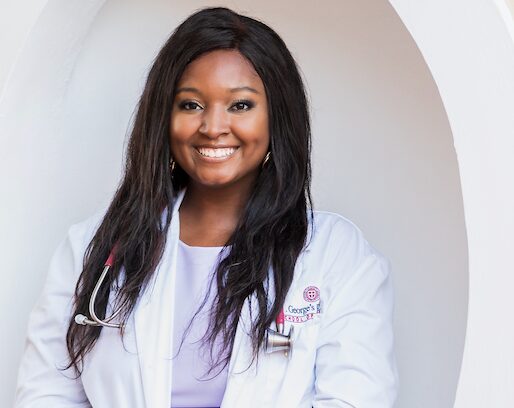
Vashti Price is a fourth-year medical student at St. George’s University. She holds a Bachelor of Science in Biology from the University of Louisiana at Lafayette, a Master’s in Biological Sciences from Alcorn State University, and a Master’s in Health Sciences from Meharry Medical College. With a strong passion for public health and health equity, Vashti has dedicated much of her time over the years to volunteering with underserved populations, including individuals experiencing homelessness and children in need. Her commitment to service continues through her involvement with the American Medical Women’s Association, where she serves on the Gender Equity Task Force and the Sex & Gender Health Collaborative Committees. Vashti is particularly interested in the intersection of medicine, public health, and community outreach. Outside of her academic and clinical pursuits, she enjoys spending time with friends and family, attending festivals, exploring new cities, and winding down with a good Netflix series.
Formatting, publication management, and editorial support for the AMWA GETF Blog by Vaishnavi J. Patel, DO