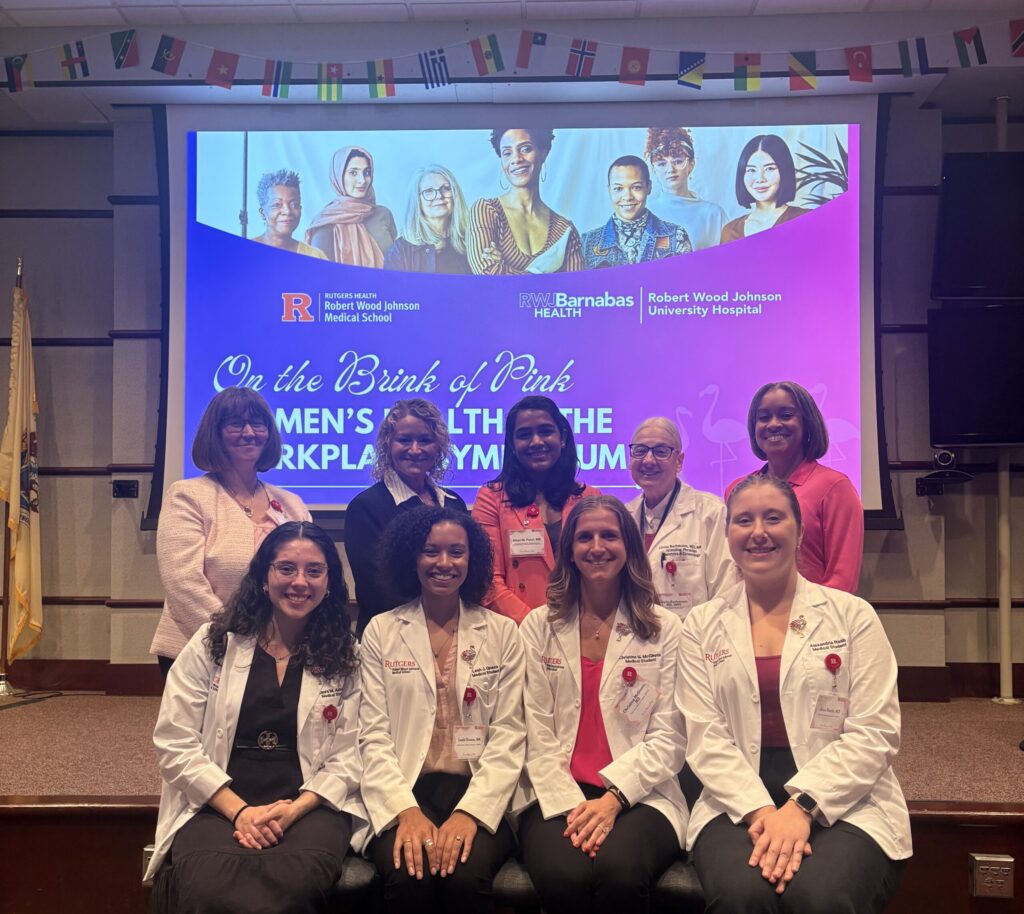
In nature, it is documented that as mother flamingos pour their energy into raising their young, their vibrant pink feathers can fade to a pale shade. As women in medicine, we face a similar challenge in trying to “do it all” while maintaining our professional identities, childcare responsibilities, and self-care. Women-specific health issues, such as menstruation, family planning, and menopause, are rarely discussed in professional settings, yet they are significant factors shaping the careers and workforce participation of women in medicine.
The symposium, “On the Brink of Pink,” was held on September 16, 2025, at the Rutgers Robert Wood Johnson Clinical Academic Building in New Brunswick, NJ. Dr. Alopi Patel, an AMWA member and Associate Professor of Anesthesiology and Perioperative Medicine, along with students from the Robert Wood Johnson Medical School (RWJMS) Chapter of AMWA, hosted the event to bring the community together to discuss health-specific issues women face in the workplace.
The keynote speaker, Dr. Amy Murtha, Dean of RWJMS, spoke about her experience as a woman in medicine. During her address, titled “Community and Leadership to Affect Change,” she emphasized the importance of mentors who understand the challenges women may encounter. Subsequent panel discussions, facilitated by medical students, focused on menstruation; family planning and fertility; pregnancy and lactation; and menopause — topics that affect nearly all women. Stigma surrounding these issues often keeps women silent when raising concerns with their employers.
During the event, participants reflected, connected, and came together to advocate for meaningful change to better support women in medicine. Just as flamingos regain their pink with proper nourishment, women at every stage of life can similarly “regain their pink” through recognition and support of their needs in the workplace.
Inspired by this theme, Christina McGinnis and Alexandra Raab, leaders of the RWJMS AMWA chapter, are currently conducting a research study to better understand the quality of life and decision-making of women-identifying medical students. Through their findings, they hope to inspire changes in medical training that address women’s health needs more directly.