
By Eliza Lo Chin, MD, MPH
Whoever would have thought that AMWA would be following baseball this summer.
It so happens that the inaugural season of the Women’s Pro Baseball League (WPBL) is underway in Springfield, Illinois, and one team, in particular, has relevance to AMWA: the Boston Hunters, named in honor of pioneering woman physician Harriot Kezia Hunt (1805-1875). Although she lived long before AMWA was founded, she was one of the first women to establish a successful medical practice in the United States – decades before Elizabeth Blackwell was the first woman to be admitted to medical school. (Harriet was denied admission twice by Harvard Medical School because she was a woman.) If you want to learn more about Dr. Hunt, consider reading her autobiography, Glances and Glimpses.
The Hunters are one of four teams launching the WPBL this year, each named for a pioneering woman who broke barriers in her field — the New York Heights (Dorothy Irene Height), Los Angeles Queens (Lizzie “Queen of Baseball” Murphy), and San Francisco Firebells (Lillie Hitchcock “Firebelle Lil” Coit). As the WPBL has said of the women who inspired its teams, the league is standing “on the shoulders of giants.”
At AMWA, we know something about standing on those shoulders. Since our founding in 1915, generations of AMWA leaders have opened doors for those who followed them.
AMWA Members Are Heading to the Ballpark
With the inaugural WPBL games taking place in Springfield, Illinois, local AMWA members are excited to be part of the enthusiasm surrounding this historic first season. AMWA Past President Dr. Susan Hingle was in the stands with her family last night cheering on the teams.
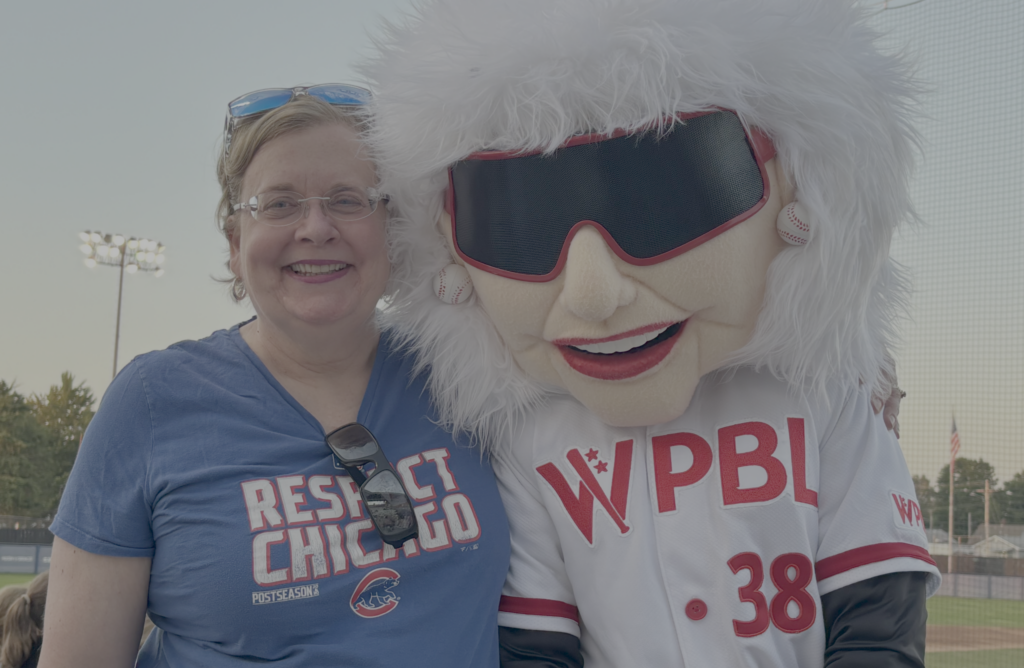
She penned this poem shortly after the game:
What the Future Looks Like
by Susan Thompson Hingle
On a summer evening in Springfield,
we went to a baseball game.
My husband.
My eldest son.
And me.
The air was unusually kind for August,
a cool breeze moving through the stadium
as if even the weather understood
that this was an evening worth lingering in.
The sun began its slow descent,
painting the sky behind the outfield,
while on the field, women played baseball.
Not women’s baseball.
Baseball.
Fast. Precise. Fierce. Beautiful.
This was the inaugural season
of the Women’s Professional Baseball League,
and somehow, improbably, wonderfully,
all of it was happening here,
in Springfield, Illinois.
There was an energy in the stands
that felt different from ordinary fandom.
People cheered loudly,
but they also kept saying something
I don’t remember hearing quite so often
at other professional sporting events:
They look like they’re having so much fun.
Again and again,
people noticed the joy.
As if excellence and joy
were not competing ambitions.
As if perhaps we had been wrong
to separate them in the first place.
And everywhere I looked, there were children.
Hundreds of them.
Little boys watching women
throw and hit and run and slide.
Little girls watching something
even more consequential:
possibility.
They were watching women
do something that, until now,
they could not grow up to do.
And suddenly they could.
Maybe that is how history changes us.
Not always with speeches
or proclamations
or monuments.
Sometimes history arrives
on a summer evening
with a glove and a bat,
under stadium lights,
while a little girl eats popcorn
and watches her future get bigger.
One of the teams was called
the Boston Hunters.
Not for an animal.
Not for a fierce mascot.
Not for a legendary athlete.
For Harriot Hunt.
A woman who, nearly two centuries ago,
wanted to become a physician
in a world that had very definite ideas
about what women could
and could not become.
Her path was difficult.
Doors closed.
Still, she persisted in caring for patients,
learning, practicing,
and claiming space in medicine
before the world was ready
to make that space for her.
And now, generations later,
her name is carried onto a baseball field
by women claiming space
in another place that once told them
they did not belong.
I loved that.
I loved that the women on the field
were honoring a woman
who had nothing to do with baseball
and everything to do with possibility.
Perhaps that is what pioneers give us.
Not simply a path to follow,
but evidence that paths can be made.
The sun dropped lower.
The breeze continued.
The players laughed and competed
and played extraordinary baseball.
Around us, children cheered.
And I found myself wondering
which of them might remember this night.
Which little girl might someday say,
I saw them play when the league was brand new.
Maybe she will become a ballplayer.
Maybe a physician.
Maybe something
we do not yet have a name for.
That may be the most beautiful thing
about witnessing a first:
you cannot know what will come after it.
You can only sit beneath a summer sky,
watch women play baseball,
listen to children cheer,
and realize that sometimes
the future does not announce itself.
Sometimes it simply takes the field.
_____________________________
Well said, Dr. Hingle.
The season is off to an amazing start. Let’s hope it stays that way. It’s great for shining a spotlight on women in professional baseball and women as trailblazers in diverse fields. And we hope that with the connection to a pioneer woman physician that more people will discover AMWA and join our efforts to level the playing field in medicine.
In the meantime, we’ll be in the stands or watching on-line, cheering on the teams.