
Authors: Rhea Manohar, MPH; Meghan Etsey, Yun Weisholtz, MD-PhD on behalf of AMWA Gender Equity Task Force
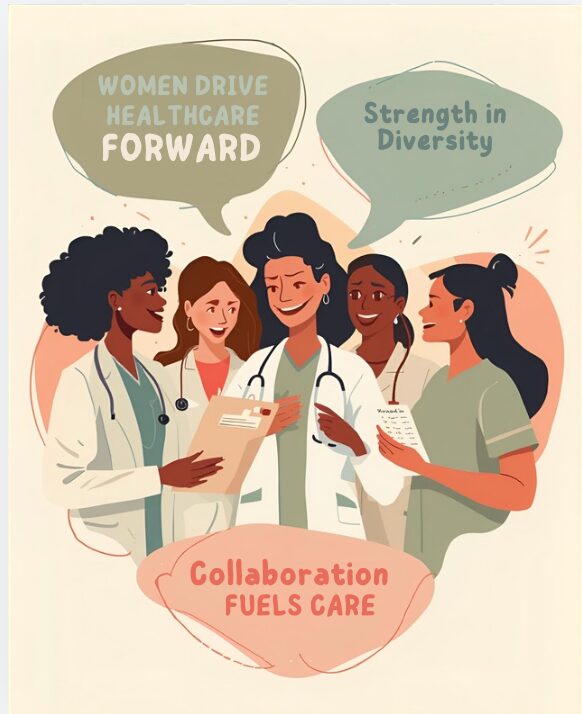
Modern healthcare is delivered by teams, not individuals. However, discussions of women in medicine are often treated in isolation. This narrow focus obscures the interconnected roles women occupy across the healthcare workforce. Celebrating individual achievement without examining how women function within interprofessional teams risks reinforcing hierarchical models of care, particularly when women-dominated professions such as nursing, therapy, and allied health are positioned as supportive rather than as clinical drivers of patient outcomes. This physician-centric and individualistic focus reflects the dominance of neoliberal feminism in medicine, which prioritizes individual achievement and economic success while obscuring the structural conditions and collective labor that sustain healthcare systems (Arruzza et al., 2019; Brown, 2015). An intersectional feminist approach challenges this narrow lens by emphasizing solidarity, collective action, and structural reform, reframing women in medicine not as isolated actors but as participants within interdependent systems of power, and by expanding the moral and political imagination of what equity in medicine can and must entail (Crenshaw, 1991).
These team effects are not just theoretical; they have measurable impacts on patient outcomes. In the United States, patients treated by female physicians experience lower mortality and readmission rates. A national Medicare study found that patients of female internists had significantly lower 30-day mortality and readmission rates than those treated by male internists (Tsugawa et al., 2017). Similar findings have been observed in surgical care, where patients of female surgeons experienced modest but statistically significant reductions in mortality, complications, and readmissions (Shannon et al., 2019). These outcomes are linked to differences in consistent practice. Female physicians are more likely to follow evidence-based guidelines, emphasize preventive care, and spend more time with patients. (Roter et al., 2002; Tsugawa et al., 2017). Communication styles also differ: female physicians demonstrate more partnership-building, active listening, and emotionally focused dialogue, all of which shape diagnostic accuracy and adherence (Roter et al., 2002).
Understanding these behaviors requires situating them within the context of team dynamics. However, these clinical behaviors do not occur in isolation. They unfold within teams. Early studies suggested that female physicians and female nurses communicated more effectively and reported higher mutual satisfaction (St-Pierre & Warsame, 2020). More recent research, however, paints a more nuanced and sometimes uncomfortable picture. Female physicians often report receiving less assistance and encountering greater communication challenges with female nurses than their male physician counterparts, highlighting how gender dynamics within teams can shape both collaboration and patient care. (St-Pierre & Warsame, 2020).
Team composition matters. In units with higher proportions of female nurses, collaboration improves, but only when there are also more female physicians present (Migotto et al., 2019). Conversely, predominantly male nursing teams working with more female physicians report lower collaboration. This highlights how gender norms and expectations shape professional interactions rather than any single role or gender (Migotto et al., 2019). What consistently predicts effective collaboration is not gender concordance alone, but time, trust, respect, credibility, and social connection. These relational factors influence morale, intent to stay, and patient outcomes (Gleddie et al., 2018). Occupational therapists, physical therapists, and other allied clinicians remain largely absent from gender-based collaboration research, despite their central role in recovery and functional outcomes. This absence reflects a broader systems problem: professions coded as “care” rather than “cure” are undervalued, understudied, and underintegrated into decision-making, despite their role in shaping patient trajectories after discharge.
Evidence suggests that female primary care physicians are more likely to engage with interprofessional teams, with a higher proportion of their patients seeing multiple clinicians than those of male physicians, even after adjusting for experience and practice setting (Funk et al., 2023). Multidisciplinary collaboration in primary care is associated with positive or neutral outcomes compared to non-collaborative models, particularly for patients with chronic disease or complex needs (Saint-Pierre et al., 2018). The implication is not that women collaborate better by default, but that they may be more willing to share authority, distribute care, and engage diverse expertise.
Patient-centered outcomes reflect the importance of gender-aware collaboration. Female patients, in particular, appear to benefit from care delivered by female physicians. Female–female patient-physician dyads are associated with longer visits, more balanced dialogue, and greater patient participation in decision-making (Bartz et al., 2020; Roter et al., 2002). Women hospitalized for myocardial infarction have higher mortality when treated by male physicians, a disparity that narrows when male physicians have greater exposure to female colleagues and patients (Shannon et al., 2019). These effects matter most in settings where symptoms are subjective, care is longitudinal, or trust is fragile, including reproductive health, chronic pain, trauma-informed care, rehabilitation, and geriatrics. In these contexts, interprofessional collaboration is not an enhancement but a requirement.
However, gender bias within teams continues to shape decision-making and career trajectories. Gender bias persists within collaborative decision-making itself. Physicians rely less on advice from inexperienced female physicians than from inexperienced male physicians, even when case complexity and information quality are equivalent (Helzer et al., 2020). Reliance on female physicians’ advice increases with seniority, whereas reliance on male physicians’ advice is more consistently weighted across experience levels (Helzer et al., 2020). These dynamics place additional burdens on early-career women physicians and may suppress diverse perspectives that improve care. Institutional norms that encourage equal attention to clinical input, regardless of source, could help mitigate these effects and improve team decision-making (Helzer et al., 2020).
Beyond individual and team-level dynamics, workforce stratification limits the impact of collaboration. Gender-diverse healthcare teams are associated with improved productivity, innovation, decision-making, and retention (Shannon et al., 2019). Interprofessional collaboration grounded in shared vision and communication has been shown to improve women’s healthcare delivery at the system level (Rayburn & Jenkins, 2021). However, the healthcare workforce remains deeply stratified. Women comprise the majority of healthcare workers but are concentrated in lower-paid roles, while leadership and authority remain disproportionately male (Joseph et al., 2021; Gupta et al., 2019). This stratification contributes to burnout, turnover, and inefficiency, all of which ultimately affect patient care.
To advance equity and optimize healthcare outcomes, it is imperative to elevate women physicians to leadership and decision-making roles, ensuring that their perspectives inform clinical and organizational priorities. Simultaneously, healthcare systems must equitably value nursing, therapy, and allied health professions, recognizing their critical contributions through appropriate staffing, pay, and authority. Addressing persistent bias in collaborative decision-making and advice-taking will ensure that all clinicians, regardless of gender or seniority, are heard and respected, ultimately improving patient care. Finally, it is essential to invest in research that examines interprofessional gender dynamics beyond nursing, expanding our understanding of how gender shapes teamwork, communication, and outcomes across all healthcare roles. Together, these actions acknowledge the interdependence of healthcare teams and demonstrate that equity is not only a moral imperative but a practical necessity for effective, patient-centered care.
Women do not simply populate healthcare teams; they also shape how these teams function. With women now a majority of future physicians and a continued high percentage in other roles within the care team (i.e., nursing, physical therapy, occupational therapy), recognizing and supporting that influence is not about optics or fairness alone. It is about building care teams capable of delivering the kind of medicine patients actually need.
References:
- Arruzza, C., Bhattacharya, T., & Fraser, N. (2019). Feminism for the 99%: A manifesto. Verso.
- Brown, W. (2015). Undoing the demos: Neoliberalism’s stealth revolution. Zone Books.
- Crenshaw, K. (1991). Mapping the margins: Intersectionality, identity politics, and violence against women of color. Stanford Law Review, 43(6), 1241–1299. https://doi.org/10.2307/1229039
- Bartz, D., Chitnis, T., Kaiser, U. B., et al. (2020). Clinical advances in sex- and gender-informed medicine to improve the health of all: A review. JAMA Internal Medicine, 180(4), 574–583. (Example link for JAMA articles, adjust if needed) https://doi.org/10.1001/jamainternmed.2019.7194
- Funk, K. A., Wahie, N., Senne, N., & Funk, R. J. (2023). Primary Care Provider Demographics and Engagement in Interprofessional Collaboration. Journal of the American Board of Family Medicine : JABFM, 36(1), 88–94. https://doi.org/10.3122/jabfm.2022.210463R1
- Helzer, E. G., Myers, C. G., Fahim, M., Sutcliffe, K. M., & Abernathy, J. H. (2020). Gender bias in collaborative medical decision making: Emergent evidence. Academic Medicine, 95(10), 1524–1532. https://academic.oup.com/academicmedicine/article/95/10/1524/8347132
- Migotto, S., Garlatti Costa, G., Ambrosi, E., Pittino, D., Balboni, B., & Palese, A. (2019). Gender issues in physician–nurse collaboration in healthcare teams: Findings from a cross-sectional study. Journal of Nursing Management, 27(8), 1773–1783. https://pubmed.ncbi.nlm.nih.gov/31529750/
- Roter, D. L., Hall, J. A., & Aoki, Y. (2002). Physician gender effects in medical communication: A meta-analytic review. JAMA, 288(6), 756–764. https://jamanetwork.com/journals/jama/fullarticle/195191
- Shannon, G., Jansen, M., Williams, K., et al. (2019). Gender equality in science, medicine, and global health: Where are we at and why does it matter? The Lancet, 393(10190), 1270–1272. https://doi.org/10.1016/S0140-6736(19)30651-8
About the Authors
Rhea Manohar, MPH, MS3

Rhea Manohar is a third year medical student from St. George’s University. She has a Masters in Public Health with a concentration in Maternal and Child Health from George Washington University Milken Institute of Public Health and a Bachelors of Science in Microbiology & Immunology, and Public Health from the University of Miami. She served as Co-VP of OB/GYN Education for St. George’s University’s Women in Medicine chapter in St. George, Grenada where she developed hands-on workshops to further reproductive health issues and navigating challenging physician-patient communication scenarios. Prior to medical school, she was a Research Associate for Fors Marsh Group, where she led qualitative and quantitative public health research and campaign development for federal agencies (e.g., CDC, NIH, DHHS, CPSC). She is also a member of the Gender Equity Task Force of the American Medical Women’s Association. When she is not pursuing medicine, you can find her reading, exploring artistic passions, and spending time connecting with friends and family.
Meghan Etsey, MS4

Meghan Etsey is a fourth year medical student from St. George’s University. She has a Bachelors of Arts in Biology and a Bachelors of Arts in Nutrition and Dietetics from Bluffton University in Bluffton, Ohio. She served as the President of the St. George’s University’s Women in Medicine chapter in St. George, Grenada where she expanded relationships with the community and worked towards educating women and helping the youth. She is also a member of the Gender Equity Task Force and Sex and Gender Health Collaborative Committees within the American Medical Women’s Association. When she is not pursuing medicine, you can find her with her friends and family on different road trips and adventures exploring the world.
Yun Weisholtz, MD-PhD

Dr. Yun Weisholtz is a physician-scientist and advisor with a deep commitment to mentorship and advancing equity in medicine. She completed her undergraduate studies at Stanford University, where she double-majored in Biological Sciences and Chemistry, and spent a year in Germany as a Fulbright Scholar. She went on to enter the MD-PhD program in Neuroscience at Harvard Medical School and MIT, where she developed her passion for research, teaching, and mentoring. Dr. Weisholtz is a Physician Advisor with MedSchoolCoach and the founder of MD-PhD Advising, a consulting practice dedicated to helping students navigate the medical school and residency application process. Outside of work, she enjoys collecting Delft pottery from the Netherlands and spending time with her family and pets.