
Authors: Rhea Manohar, MPH; Meghan Etsey, Sydney Li, Vaishnavi Patel, DO on behalf of AMWA Gender Equity Task Force
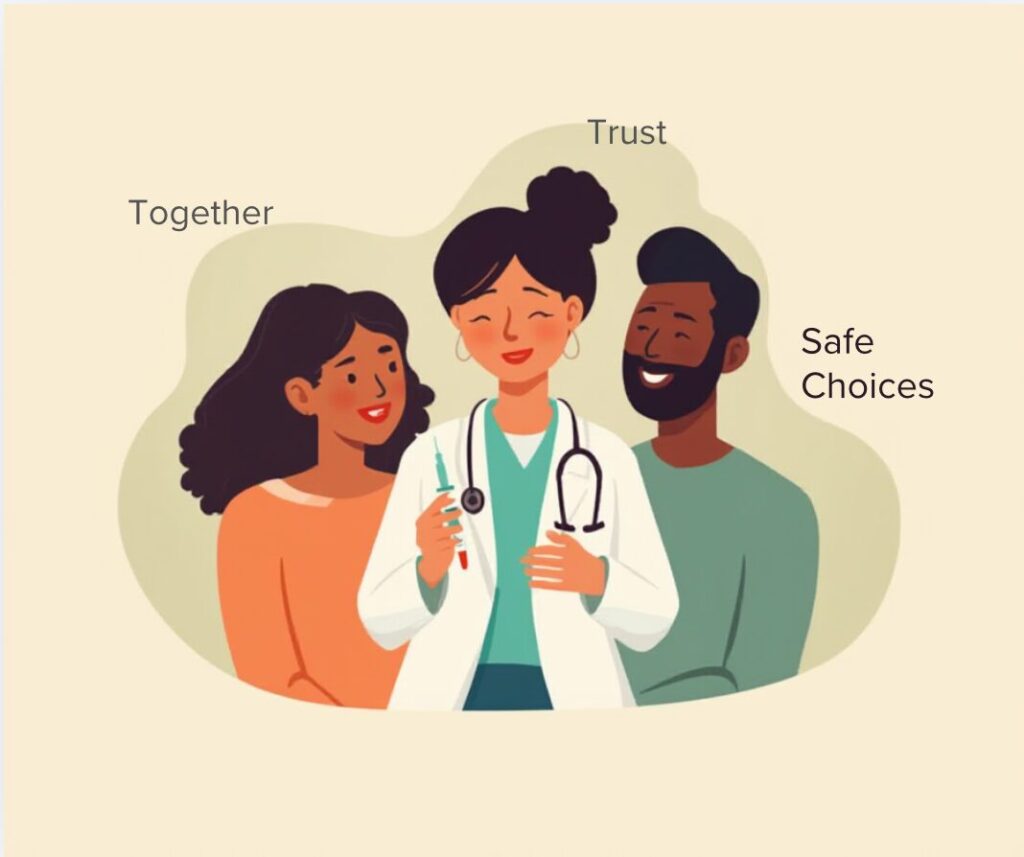
Being a parent in medicine today can feel profoundly vulnerable. Recommendations evolve rapidly, headlines shift, and studies can trend on social media before most clinicians have fully reviewed the methodology. The effects are trickling down into exam rooms across the country, where parents are trying to do what they have always tried to do: protect their children.
As physicians and trainees, we are trained to interpret evidence, weigh risk, and translate uncertainty. But parents are navigating that same uncertainty without the infrastructure we rely on daily. Vaccine conversations are often framed as adversarial, pitting hesitant parents against pro-vaccine clinicians. In reality, both sides share the same goal: protecting children’s health. . We both want healthy children. We both want safety. The tension stems not from opposition but from the emotional burden of responsibility.
For the first time, the American Academy of Pediatrics and Centers for Disease Control have released childhood vaccination recommendations which differ both in which vaccines are recommended as well as their scheduling. Despite these changes, recent national polling continues to show that most parents believe routine childhood vaccines are important for their communities and express confidence in their safety, particularly for longstanding vaccines such as Measles, Mumps, and Rubella (MMR) and Polio (KFF/Washington Post Survey, 2025). Attitudes toward vaccination vary by type. Confidence in influenza and COVID-19 vaccines remains more divided, with fewer parents perceiving COVID-19 vaccination for children as essential to community health (Kaiser Family Foundation & The Washington Post, 2025). Vaccine confidence is not a single construct; it is vaccine-specific, context-dependent, and influenced by recent public health experiences.
Safety concerns are the main reason parents delay or refuse vaccines, cited by 38–42% of parents (Giambi et al., 2018). These concerns include fears of short-term adverse reactions (reported by 60–86% depending on vaccine attitude), long-term effects (44–95%), vaccine ingredients, immune “overload,” and the perception that children receive too many vaccines at once (Gidengil et al., 2019; Giambi et al., 2018; O’Leary, 2025). These anxieties are consistent across countries and healthcare systems.
Hesitancy is not evenly distributed. Parents expressing vaccine safety concerns are more often younger, have lower educational attainment or household income, and may identify as more religious (Kempe et al., 2020; Reuben et al., 2020; Zheng et al., 2025). Vaccine hesitancy is also associated with preference for natural or holistic health approaches and with greater mistrust of the medical profession (Majid & Ahmad, 2020; Reuben et al., 2020).
Patterns further vary by race, ethnicity, gender, and geographic location (Zheng et al., 2025). Certain geographic clusters, which are often tied to shared religious or cultural identities, demonstrate higher rates of vaccine refusal, contributing to localized outbreaks of vaccine-preventable diseases (O’Leary et al., 2024). In these settings, hesitancy reflects not only individual decision-making, but also community norms and information ecosystems.
The broader informational landscape plays a measurable role. While many parents still rely on healthcare providers for vaccine information, exposure to discordant opinions, non-traditional medical narratives, or personal stories of adverse reactions increases hesitancy; thereby leading to a growing subset of parents who are increasingly hesitant about vaccine recommendations (KFF/Washington Post Survey, 2025). Research conducted during and after the COVID-19 pandemic demonstrates that attitudes toward vaccines are highly influenced by perceived safety, institutional trust, and clarity of communication (Eiden et al., 2025).
Contemporary surveys continue to show that pediatricians and primary care clinicians remain the most trusted source of vaccine information. This is seen even among parents who report hesitancy (KFF/Washington Post Survey, 2025). However, trust in federal health institutions has become more polarized, particularly since the COVID-19 pandemic. Many parents who express skepticism toward public health agencies still report confidence in their child’s personal physician (KFF/Washington Post Survey, 2025). That distinction underscores the protective role of the clinician-parent relationship and the opportunity for physicians to bridge the gap.
Vaccine literacy also shapes decision-making. Parents with lower vaccine literacy demonstrate greater hesitancy (Zheng et al., 2025). Conversely, positive interactions with healthcare providers and active information-seeking behaviors are associated with higher literacy and lower hesitancy (Zheng et al., 2025). Evidence suggests that improved educational outreach and clearer safety communication may increase vaccine acceptance among hesitant groups (Eiden et al., 2025). With the evolving recommendations, trust becomes the fulcrum and the exam room becomes sacred space now more than ever.
Contrary to popular belief, when a parent hesitates, it is rarely because they reject medicine outright. More often, they are overwhelmed by the pace of change. Recommendations evolve. Booster guidance shifts. Public health messaging adapts in response to emerging data. For clinicians, this evolution reflects scientific rigor and ongoing surveillance. For parents, it can feel destabilizing and lead to greater confusion about what is best for their child.
It is hard to be a parent when recommendations change.
It is hard to navigate competing narratives about safety.
It is hard to carry the weight of a decision that feels permanent.
Rather than putting parents on the defensive, evidence-based communication strategies emphasize listening first, affirming parental intent to protect their child, and offering clear, confident recommendations while remaining open to dialogue (Limaye et al., 2021; O’Leary, 2025; O’Leary et al., 2024). The goal is not to overwhelm families with statistics, but to anchor discussions in shared values.
Vaccine hesitancy intersects with socioeconomic disparities, religious identity, cultural norms, health literacy, and institutional mistrust shaped by lived experience. Addressing hesitancy requires more than data, it requires humility.
We may sit on opposite sides of the exam table. Parents on one side. Physicians on the other.
But that table is not a battlefield. It is a meeting place.
When we approach vaccine conversations with empathy instead of defensiveness, we preserve the most powerful intervention we have: trust.
Trust that allows parents to ask questions without shame.
Trust that allows clinicians to make strong recommendations without coercion.
Trust that acknowledges we are motivated by the same goal: protecting children.
Parents and physicians are not opposing teams.
We are allies navigating an increasingly complex information landscape together.
Strengthening that alliance may be one of the most important forms of preventive medicine we practice.
References:
- Bianco, A., Mascaro, V., Zucco, R., & Pavia, M. (2019). Parent perspectives on childhood vaccination: How to deal with vaccine hesitancy and refusal? Vaccine, 37(7), 984–990. https://doi.org/10.1016/j.vaccine.2018.12.062
- Eiden, A. L., Frew, P. M., Wang, D., et al. (2025). Determinants of vaccine attitudes and implications for parental decision-making. Vaccine. https://www.sciencedirect.com/science/article/pii/S0264410X25001045
- Gidengil, C., Chen, C., Parker, A. M., Nowak, S., & Matthews, L. (2019). Beliefs around childhood vaccines in the United States: A systematic review. Vaccine, 37(45), 6793–6802. https://doi.org/10.1016/j.vaccine.2019.08.068
- Giambi, C., Fabiani, M., D’Ancona, F., et al. (2018). Parental vaccine hesitancy in Italy: Results from a national survey. Vaccine, 36(6), 779–787. https://doi.org/10.1016/j.vaccine.2017.12.074
- Kaiser Family Foundation (KFF) & The Washington Post. (2025). KFF/The Washington Post survey of parents: Polling insights on the MAHA movement. https://www.kff.org/public-opinion/kff-the-washington-post-survey-of-parents-polling-insights-on-the-maha-movement/
- Kempe, A., Saville, A. W., Albertin, C., et al. (2020). Parental hesitancy about routine childhood and influenza vaccinations: A national survey. Pediatrics, 146(1). https://doi.org/10.1542/peds.2019-3846
- Limaye, R. J., Opel, D. J., Dempsey, A., et al. (2021). Communicating with vaccine-hesitant parents: A narrative review. Academic Pediatrics, 21(4), S128–S136. https://doi.org/10.1016/j.acap.2020.10.007
- Majid, U., & Ahmad, M. (2020). The factors that promote vaccine hesitancy, rejection, or delay in parents. Qualitative Health Research, 30(11), 1762–1776. https://doi.org/10.1177/1049732320933863
- O’Leary S. T. (2025). Strategies for Communicating With Parents About Vaccines. JAMA, 333(24), 2197–2198. https://doi.org/10.1001/jama.2025.4882
- O’Leary, S. T., Opel, D. J., Cataldi, J. R., & Hackell, J. M. (2024). Strategies for improving vaccine communication and uptake. Pediatrics, 153(2). https://doi.org/10.1542/peds.2023-064123
- Reuben, R., Aitken, D., Freedman, J. L., & Einstein, G. (2020). Mistrust of the medical profession and higher disgust sensitivity predict parental vaccine hesitancy. PLOS ONE, 15(9). https://doi.org/10.1371/journal.pone.0237755
- Zheng, Y., Frew, P. M., Wang, D., & Eiden, A. L. (2025). Factors associated with parental literacy and hesitancy toward pediatric vaccination. BMC Public Health. https://pmc.ncbi.nlm.nih.gov/articles/PMC12567618/
About the Authors:
Rhea Manohar, MPH, MS3

Rhea Manohar is a third year medical student from St. George’s University. She has a Masters in Public Health with a concentration in Maternal and Child Health from George Washington University Milken Institute of Public Health and a Bachelors of Science in Microbiology, Immunology, and Public Health from the University of Miami. She served as Co-VP of OB/GYN Education for St. George’s University’s Women in Medicine chapter in St. George, Grenada where she developed and implemented hands-on workshops to further reproductive health issues and bolstered medical students abilities to navigate physician-patient communication. Prior to medical school, she was a Research Associate for Fors Marsh Group, where she led qualitative and quantitative public health research and campaign development for federal agencies (e.g., CDC, NIH, DHHS, CPSC). She is also a member of the Gender Equity Task Force and Reproductive Health Coalition within the American Medical Women’s Association. When she is not pursuing medicine, you can find her reading, exploring artistic passions, and spending time connecting with friends and family.
Meghan Etsey, MS4
Meghan Etsey is a fourth year medical student from St. George’s University. She has a Bachelors of Arts in Biology and a Bachelors of Arts in Nutrition and Dietetics from Bluffton University in Bluffton, Ohio. She served as the President of the St. George’s University’s Women in Medicine chapter in St. George, Grenada where she expanded relationships with the community and worked towards educating women and helping the youth. She is also a member of the Gender Equity Task Force and Sex and Gender Health Collaborative Committees within the American Medical Women’s Association. When she is not pursuing medicine, you can find her with her friends and family on different road trips and adventures exploring the world.
Sydney Li, MS3

Sydney Li is a third-year medical student at St. George’s University, dedicated to advancing clinical knowledge, compassionate patient care, and promoting equitable communities. She strongly believes in nurturing community connections, supporting green spaces, and valuing social advocacy as integral parts of health and medicine. Sydney holds a Bachelor of Science in Population Health from Vancouver, Canada, and previously worked on the global Prospective Rural and Epidemiology (PURE) study, which investigates how societal factors influence chronic disease. Outside of medicine, you can find her on a mountain or local beach, exploring her neighbourhood cafes, or admiring her local park.

Vaishnavi J. Patel, DO is an early career family medicine physician. She is passionate about Women’s Health and advocacy, serving on the Executive Board of the American Medical Women’s Association GETF and playing a crucial role in their initiatives to support women in medicine. Her research expertise includes scientific computation, data sciences, and analyzing methods to improve patient outcomes and women’s health. She is a dedicated volunteer for local free clinics and a speaker at various programs focused on patient education and advocacy. She serves as an ambassador of the Gold Humanism Honor Society and is a recipient of the Lifetime Presidential Volunteer Service Award and the Eliza Lo Chin Unsung Hero Award. In her spare time, she enjoys archery, reading, spending time with her family, and spoiling her pets. Her patients describe her as compassionate, thorough, and knowledgeable. Her classmates, coworkers, and mentors describe her as a genuine leader, hard-worker, and a valuable asset to the future of medicine.