
Authors: Dr. Joanna Georgakas, Vashti Price, Meghan Etsey, Dr. Laura Helfman on behalf of AMWA Gender Equity Task Force
“Our Voices, Our Future” is a podcast by the Gender Equity Task Force of the American Medical Women’s Association that explores the challenges, stories, and successes of those working to advance gender equity in medicine. Through candid conversations with changemakers, advocates, and leaders, each episode dives into issues like pay gaps, leadership disparities, and inclusive workplace culture. Tune in to be inspired, informed, and empowered to take action. Full episode listening links are available below the transcription.
Dr. Georgakas: Welcome back to Dr. Anne, Multidimensional Women in Medicine. I’m your host, Joanna Georgakas, and on today’s episode, we’ll be continuing our conversation with Dr. Laura Helfman.
In our previous episode, we discussed Dr. Helfman’s role as a White River Raft Guide and Wilderness Medicine Educator. In this episode, we’ll be talking with her in depth about her role with the American Women’s Hospital Service, the charitable arm of AMWA, and her advocacy work with the Single Payer Medicare for All Movement.
Dr. Helfman, welcome back.
Dr. Helfman: Thanks for having me.
Dr. Georgakas:
I thought we’d start our conversation today by discussing the American Women’s Hospital Service. Dr. Helfman, would you mind telling us a little bit more about this organization?
Dr. Helfman: Well, that could be a podcast in itself. The American Women’s Hospital Service, AWHS, was actually founded in 1917, I believe, by some members who were active in AMWA. The motivation for starting the service back then was that there were many American medical women doctors who wanted to help in the World War I effort in a medical capacity over in Europe, but they were denied. They were told that only men could be doctors and that they could volunteer as nurses. They didn’t like that much.
So they went over there into what would now be Croatia and that general area of the world, where there were a lot of war victims — women and children primarily — who were not getting any medical care. They started hospitals and orphanages and took care of the people the Army wasn’t taking care of. They actually went over with the supplies, built the structures, and provided the care.
Eventually, what happened was that it became more of a charitable organization that fundraises and then, in turn, donates that money to existing clinics that are doing good work, especially if their main mission is to support both the health of women and children, as well as the promotion of women as providers or as independent people.
So the modern-day equivalent of AWHS, which stems from the original, is that we are funding two international clinics, one in Nepal and one in Uganda, and several small initiatives in the United States. We also fund travel grants for medical students and residents to travel to a clinic or a country of their choosing, as long as it’s an organized medical activity, to both give service and hopefully bring back some worthwhile knowledge that will promote better care globally.
Dr. Georgakas: That sounds amazing.
Dr. Helfman: I did myself receive a grant in one of the early days they were promoting the grant for travel, which was when I was a resident. So it would have been about 1991 or 1992. I traveled to Bolivia to a clinic that was quite famous back then, run by Dr. Ruth Tischauer.
There are actually YouTube videos about her. She worked in Bolivia from the 40s, I believe, when she left Germany, until she died probably ten years ago. She ran what she called the “Clinics Under the Olive Tree” and various other things.. So I went down and worked with her.
Dr. Georgakas:
I know that a lot of our listener base are pre-medical students, medical students, and other medical professionals. If they were interested in participating or getting involved with the American Women’s Hospital Service, what are the ways you would recommend they reach out?
Dr. Helfman: To get in touch with us, I think the best way is the email [email protected]. If that doesn’t work, just find the AMWA email, go to the AWHS page, and there’s probably a “contact us” button.
Dr. Georgakas: Great. I’ll have that listed in our show notes too for those tuning in. You can click right from there if you’re driving right now and want to get in contact when you stop.
So I know the organization offers travel grants to help in the clinics, but is there any other way that people can get involved or help out?
Dr. Helfman: If they want to apply for a grant, all the application information is right on the AWHS link, which is embedded within AMWA. If they want to join the committee, and we are always looking for members, they can probably contact me directly, so we can put that email in the show notes as well.
We’re always looking for people to help with the evaluation of applications. More importantly, right now we’re looking for anyone who might have expertise with Facebook as a way to promote a page. We’re also looking for people with any graphic expertise because we want to maybe redo the brochure and restart an initiative from a few years ago called Postcards, where we did a simple one-page PDF or hard copy for some of our members who don’t use the Internet, as a way to let them know what’s going on and hopefully solicit funds from that. Anyone who is artistic, has graphic design abilities, and wants to join, we would love to have you, and anyone else as well.
Dr. Georgakas: Just to put in a quick plug for AWHS, I know that they are currently accepting applications for new members, and applications for this cycle are actually due on May 29th, so at the end of this month. If you’re interested, definitely check it out. I’ll post the link for the application down in the show notes as well.
Dr. Helfman, I know that you’re an advocate and activist in many other ways as well, not just through your work with AWHS. I wanted to take a little time to also talk to you about your work as an advocate and activist for the Single Payer Health Care Movement.
Dr. Helfman: Absolutely. We just actually had our national meeting in Philadelphia. The Physicians for a National Health Program is an organization of, I’ve lost track of how many members, because it has grown significantly in the last few years.
Basically, it started as a group of physicians in the Boston area who felt that our current system, and we’re talking about 30 or more years ago, when our current system wasn’t as dysfunctional as it is now, but they felt that there was a lot of care for the haves and no care for the have-nots, and that there were an awful lot of people who were not covered and had no access to care. They felt that the insurance system, with its profit motive, was partially to blame for that, or maybe mostly to blame for that.
So they developed the concept of a single-payer Medicare for All. They modeled it more or less on Canada’s plan, which started in 1965 or so. When we got Medicare, Canada was going through a similar crisis, and they developed their own Medicare for everyone. They call it the same, and it covers everyone from the day of birth to the day you die. It is pretty comprehensive in terms of services.
We probably don’t have time to get into the fears of rationing and whatnot, but they studied all of that and found that we ration care here in the U.S., because if you have insurance, you get care, and if you don’t have good insurance, you don’t get care. If you cut out the middleman, the insurance company, you would have more money, and therefore everyone could get more care.
Our cost of care is more than double that of almost every other country that would be considered our peer. All of those countries cover everyone, and we have 30 million uninsured, and yet our outcomes are uniformly worse, including the fact that our age expectation is lower than every other country. Our age expectation is going down while everyone else’s is going up. They’re spending less money, and they’re providing more care.
So that is, in a nutshell, why I became so involved with the Single Payer Movement and why I continue to advocate for it. As far as the role I play, it’s basically just as an advocate. I’ve done a few talks at Rotary Clubs and a few radio shows.
I have a couple of op-eds that I’m working on, and I’m waiting for the right moment to send them in. And I talk to a lot of people about it. I’ve had more talks about Single Payer with Uber and Lyft drivers, and they’re very, very receptive. Whenever I can talk about Single Payer, I do.
Dr. Georgakas:
I know as a physician, even throughout my medical training, even though I’m not quite there yet, they tell us that it’s really important to use our voice to advocate for issues we really care about. Why do you feel like it’s important to be active on such issues as a physician?
Dr. Helfman: Well, people do actually have respect for physicians. They may not like what’s going on with their medical insurance, they may not like what’s happened to their health, but in general, they do look up to physicians. They feel that we have a lot of education, and therefore what we have to say may be important. So, although all these issues are important, we would hope that everyone would listen to anyone who wants to speak about them. I think we do share a little special role when it comes to advocating for issues that we think will benefit the world and our patients.
Dr. Georgakas:
I know you do a lot in terms of advocacy, your work with AMWA, your work with the American Women’s Hospital Service, as well as your clinic and your time as a Whitewater River Guide. How do you manage to juggle all those various interests and hats you wear?
Dr. Helfman: Well, I have to put things in certain times of the year, times of the day. There are times when I’m doing much more of one and much less of another. For instance, in the winter, there isn’t much call for Whitewater River Guiding, although I occasionally will get on the river myself and just block it out on my calendar.
In addition, I accept that I will not get everything done by the end of the day, and I try to do the things that have the most urgent deadline. For instance, I had to do some CME to renew my Florida license in January. That was at the top of the list, but last June, it was at the bottom of the list.
Just having lists and doing the things that are most crucial, and putting things aside when they’re not crucial. Because if I didn’t, otherwise I would never get to spend any time with my husband or my cats, or clean the house, or whatever else you have to do.
Dr. Georgakas: All those small things actually really do matter too in keeping us from burning out.
I know the very first time I spoke with you, you said something that really resonated with me. You were talking about the mentality that many of us who decide to go into medicine have — this impression that we need to be the best, and a false idea of success being tied to the time we spend at work or working. Can you talk more about this with our audience?
Dr. Helfman: Sure. I mean, I think that concept has actually taken hold in the medical world since the first time I thought about it, which was really way back when I was in medical school. I was actually introduced to a woman who became my mentor, who got me involved with working with the Women’s Health Center in Philadelphia, and making sure that all my time was well spent and that it wasn’t all strictly academic medicine.
I would say such things as, “I’m going to go away this weekend and go hiking because I need that for my mental health,” and my other students would think I was crazy. Or I would say that I may not work full-time, or I may find a way to do third-world work, which is now called global medicine. My fellow students would say they were so tied up in achieving whatever people viewed as a successful medical career that they couldn’t imagine any other things interfering.
But now there is so much talk about work–life balance, and I really think that’s what I’m saying, that maybe you’re not going to be the full professor by age 45 if you take time off to do a mission trip, or you take a sabbatical to sail around the world with your spouse and your family, or you don’t work a 60-hour week, you take a two-thirds position, and that gives you time to do the things that are important to you.
I don’t think it’s unique anymore. I think with the level of burnout we’re seeing in medicine, that’s actually becoming pretty high on the list, not just for individual physicians or other medical providers, but actually high on the list of what residencies are working on and medical students are working on, because we don’t want to have a whole bunch of, well, we do have a whole bunch of burned-out doctors, and we need to do something about it.
Making sure that people have a good mental attitude and want to go to work when they head to work, because they want to help people, instead of going in aggravated, doing good medicine but not doing very good people-care, then there’s no point. So we have to get back to, not necessarily Marcus Welby, but we have to get back to the point where a physician did what they did because they had an overwhelming desire to help humanity, and they enjoyed doing it.
I think that’s big too, just taking time to pursue your interests outside of medicine, or even if they’re related to medicine but a tangent of clinical practice. I think it helps rejuvenate most of us who are able to split that time and spend time outside of the hospital setting. It makes us better doctors inside the hospital setting.
Dr. Georgakas: Agreed.
So just a note to end on, what advice do you have for our trainees listening in about pursuing passions outside of medicine?
Dr. Helfman: Well, make sure that you figure out what it is that makes you passionate. There’s a woman who’s involved with the Wilderness Medical Society who founded the medical clinic at the base camp of Everest, and she gave a talk where she said, “You need to follow your bliss.”
So whatever that bliss is, whether it’s hiking in nature, music, pottery, volunteering, whatever, know what that is and set time for it. And recognize that you can never memorize the textbook. Nowadays we have the internet, so that makes things a whole lot easier than in the old days. You can’t memorize it all. You can’t know it all.
You’re not going to be the smartest, because everyone who is your peer is also smart. So recognize that you need to take time for yourself. I would never study the night before a big exam. I would just stop at six o’clock and say, “I’m going to…”, whatever it was, sometimes see a movie, go out and get some ice cream, because I felt that last-minute studying didn’t help and just added to my agitation about it.
So make sure you put in other times for yourself where you do something that is just for you, or maybe you and your family, or you and your friends, and know that you’re still going to be a good doctor. And if you have a good heart for it, then all the studying in the world can’t take that away. A good heart can only persist if you’re happy. Once you become unhappy, then that part of you is lost.
Dr. Georgakas: Absolutely. That’s so well said. Thanks so much for chatting with us today, Dr. Helfman.
Dr. Helfman: You’re welcome. I enjoyed it.
Dr. Georgakas: Thanks to our listeners tuning in. For more information about all the topics we discussed today, how to contact the American Women’s Hospital Service, and more information about the Single Payer Medicare for All Movement, please be sure to check out our show notes.
If you’re interested in learning more about the podcast or being featured in an upcoming episode, you can find our contact information in the show notes. Thank you to the American Medical Women’s Association for supporting the series. For more ways to be engaged in the community and meet more incredible women in medicine, sign up to be a member today.
Hope to see you at the next conference.
Links to our podcast:
RSS https://rss.com/podcasts/our-voices-our-future/
Apple Podcast https://podcasts.apple.com/podcast/id1805991643
Spotify https://open.spotify.com/show/5E59jvuFQOjSXfLrjQiy0P
Podcast Index https://podcastindex.org/podcast/7278557
Fountain https://fountain.fm/show/7278557
True Fans https://truefans.fm/82727577-2b37-5929-aa2e-1574d478b177
About the Authors
Joanna Georgakas, MD
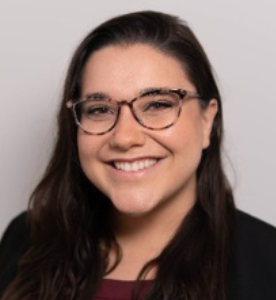
Joanna Georgakas, MD, is a psychiatrist and a Clinical Fellow in Geriatric Psychiatry at Mass General Brigham in Boston, MA. Dr. Georgakas received her BA from Middlebury College, where she majored in Neuroscience and Gender, Feminist and Sexuality Studies. She earned her medical degree from the Alpert Medical School of Brown University and subsequently completed her psychiatry residency training at Brown, serving as Chief Resident. Dr. Georgakas’s academic work has focused on the “leaky pipeline” phenomenon for women in STEM fields and feminist science studies. She has been an active member of the American Medical Women’s Association (AMWA) since 2018, where her contributions include co-founding the Brown University AMWA chapter and serving on the AMWA Gender Equity Task Force. She also created the podcast series “ Doctor and ____: Multidimensional Women in Medicine” (now run by incredible students and called “Our Voices, Our Future”) to elevate the narratives of women advancing gender equity in medicine. In recognition of her contributions, Dr. Georgakas was a recipient of the AMWA Eliza Chin Unsung Hero Award.
Vashti Price, MS, MHS, MS4
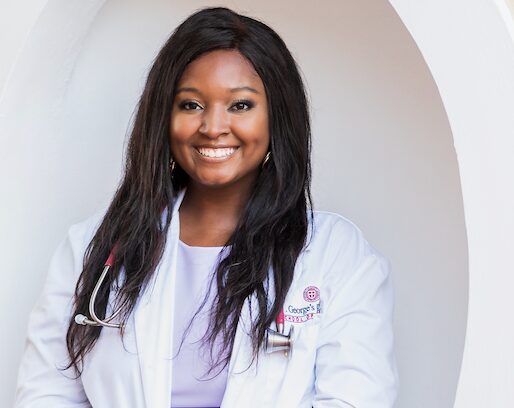
Vashti Price is a fourth-year medical student at St. George’s University. She holds a Bachelor of Science in Biology from the University of Louisiana at Lafayette, a Master’s in Biological Sciences from Alcorn State University, and a Master’s in Health Sciences from Meharry Medical College. With a strong passion for public health and health equity, Vashti has dedicated much of her time over the years to volunteering with underserved populations, including individuals experiencing homelessness and children in need. Her commitment to service continues through her involvement with the American Medical Women’s Association, where she serves on the Gender Equity Task Force and the Sex & Gender Health Collaborative Committees. Vashti is particularly interested in the intersection of medicine, public health, and community outreach. Outside of her academic and clinical pursuits, she enjoys spending time with friends and family, attending festivals, exploring new cities, and winding down with a good Netflix series.
Meghan Etsey, MS4
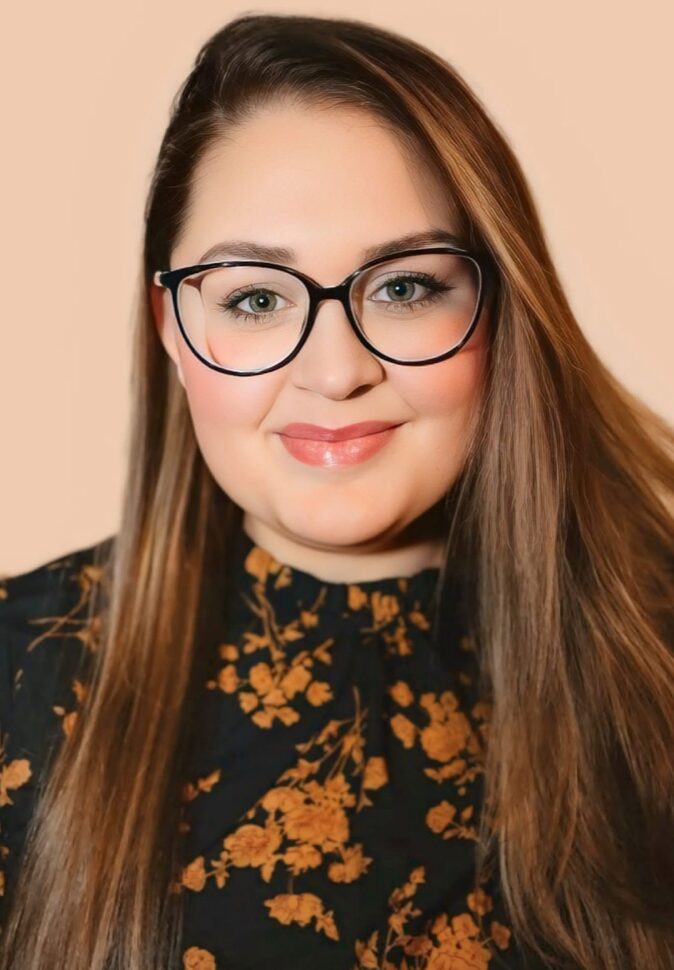
Meghan Etsey is a fourth year medical student from St. George’s University. She has a Bachelors of Arts in Biology and a Bachelors of Arts in Nutrition and Dietetics from Bluffton University in Bluffton, Ohio. She served as the President of the St. George’s University’s Women in Medicine chapter in St. George, Grenada where she expanded relationships with the community and worked towards educating women and helping the youth. She is also a member of the Gender Equity Task Force and Sex and Gender Health Collaborative Committees within the American Medical Women’s Association. When she is not pursuing medicine, you can find her with her friends and family on different road trips and adventures exploring the world.
Formatting, publication management, and editorial support for the AMWA GETF Blog by Vaishnavi J. Patel, DO