My mother always told me I had the most vivid imagination. I channeled this creativity into stories about talking animals, garbage-truck adventures, and even encounters with God.
I even concocted a story about a girl in my elementary school class whom I called Mary. Over the course of the school year, I came home each evening and made my parents laugh about Mary’s antics, including her bellowing laugh and the characteristic way she would cross her arms and march around the classroom. This, of course, was when she was not being sent to the principal’s office for her behavior, descriptions of which would also leave my parents in stitches.
The day of the open house at school arrived, and my parents eagerly awaited meeting this jolly miscreant who had become my friend. While I proudly pointed to artwork I had created that hung on the walls and a dinosaur diorama displayed on my little desk, I noticed my father looking around the room, and my mother’s eyes following his.
When we got home, he asked, “Where was Mary?”
I looked at him and replied very matter-of-factly, “I made her up. She doesn’t exist.”
I don’t remember their voices, only their faces: a mix of horror and awe. When my mother sat me down to understand exactly why I had made up a character from school over the past nine months, I explained, “Look how happy I made you and Dad! I made you laugh every night this entire school year.”
She shook her head and held me, which she has continued to do my entire life. But she advised me to continue to use this creative energy to write stories—creative stories like the ones about my encounters with God and the fictional Mary, and stories about my own life.
And so, I wrote. I filled up my Hello Kitty notebook that my mother gifted me when I was five. I even chose English as my major in college so I could keep writing. And I have continued to write throughout medical school, residency, fellowship, and as a faculty member in academic medicine.
Writing was not only an outlet, but also a way of telling a compelling story that gave life and meaning to my experiences while honoring the stories of those around me. As a physician, writing helped me process the myriad competing emotions that often accompany the work of healing others.
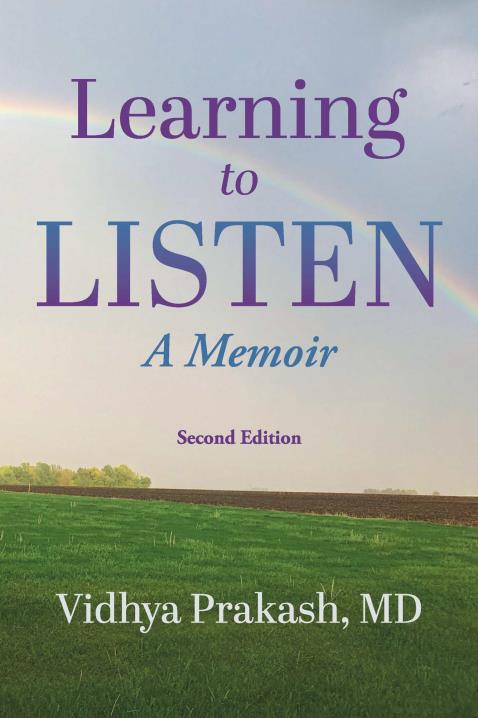
In 2021, I pieced together all my writings into a book, Learning to Listen: A Memoir. Why did I write this book? I wanted to share my story with my children, so they would know what life was like for a little Indian girl growing up in the United States—one who loved to write and was eventually called to heal. I wanted my husband and parents to know how much their love and support influenced my path to becoming a physician and a parent. And I wanted other budding physicians to know that they were not alone in any feelings of uncertainty or self-doubt in their journey.
I hoped to share my struggles, triumphs, and all the champions along the way who helped me find my footing and, in turn, help others find theirs. Importantly, I wanted to make people laugh, just as I did my parents with my stories about Mary—only these stories are real. Finally, I hoped to share the great lesson that I learned: that the most impactful storyteller can only share a compelling story by first listening.
I just published the second edition of Learning to Listen: A Memoir. It is a very lightly edited version of the first edition, released through a publishing company I trust. This book would not have been possible without the love and support I received from my AMWA family. If it takes a village to raise a child, it takes an equally vital village to shape a physician leader, and AMWA was just the community I needed.
All royalties from this book will be donated to AMWA to support its enduring mission to advance women physicians and improve the health of women—my way of giving back to a beloved family that supported me throughout my own journey.
By Vidhya Prakash
https://www.linkedin.com/in/vidhya-prakash-74b88773