
Tips for recognizing and managing healthcare burnout throughout your medical education, training, and practice.
by Dr. Tianne Foster, a globally trained medical professional specializing in burnout prevention and workplace well-being, integrating conflict management as a key factor in team dynamics. As the author of Reality Check: Recognize Burnout, Prevent It, and Discover How to Live Well, Dr. Foster analyzes workplace insights for healthcare professionals and organizations and delivers practical tools to address burnout, optimize team dynamics, and enhance systemic well-being.
What is Healthcare Burnout?
Burnout is recognized as an occupational syndrome, though it is not classified as a mental disorder or medical diagnosis. The syndrome leads people to feelings of exhaustion, reduced personal accomplishment and/or cynicism. It is different from stress and depression, although these constructs are closely related. Unaddressed and repeated workplace stressors can lead to burnout, and unaddressed and ongoing burnout can progress to affect multiple areas of one’s life, contributing to depression.
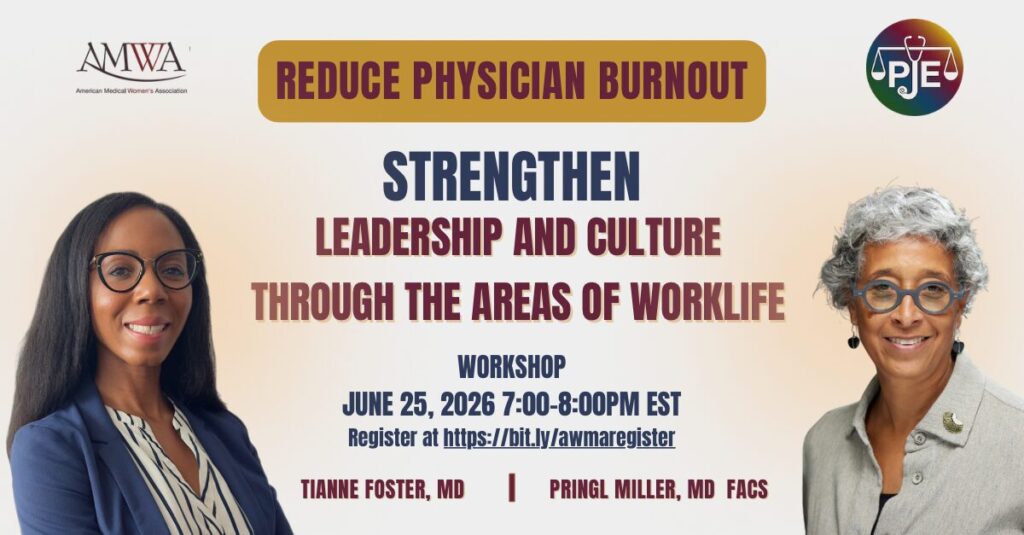
For a deeper discussion and strategies to improve outcomes, join us for a workshop on June 25, 2026, at 7 pm ET: Strengthening Leadership and Culture through the Areas of Work-Life to Reduce Physician Burnout. REGISTER
Consequences of Burnout
Burnout affects individuals, organizations, and patients in many ways. It can result in physical
illnesses, reduced productivity, strained workplace relationships, incivility and medical errors.
For those experiencing burnout, physical health effects such as insomnia, increased susceptibility
to injury or illness, and mental health concerns like depression are risks of burnout. When burned
out, one soon begins to dread the workplace.
Consequences of Burnout for Patients
For patients, care tends to suffer at the extremes of burnout, when effective communication is compromised. The exhaustion from burnout can impact the interaction with patients, leading to poor patient experience and possible medical errors.
Impact of Burnout for Organizations
For organizations, the productivity of staff members suffers when burnout, low morale, and increased illness lead to greater absenteeism. A shortage of staff causes unsafe work conditions, increasing the risk of costly medical errors. As shortages cause added stress and strain on the remaining staff, incivility can increase, and soon they too will burn out. Overall, the satisfaction rating of such organizations will suffer along with heightened costs to replace burned
out staff.
What to Know About Burnout as a Physician
Physicians are not exempt from burnout. As much as we tend to steel ourselves up along the trajectory of our training to think that once we reach the next stage, the issues will resolve, this is not always the case. Each stage of our training and lives may present new challenges that may drive the development of burnout.
For physicians in the workforce, difficulties in the six areas called the “Areas of Worklife, developed by psychologists Christina Maslach and Michael Leiter, can contribute to your levels of burnout. Your workload is just one aspect, but it may not always be the factor leading to burnout. Additional areas of this validated measure include fairness, value, reward, control and community.
The Areas of Worklife Survey scores your perceptions across these six domains, showing how well you align with your work environment. Misalignment signals risk of burnout. If you’re curious but don’t know where to start, you can build awareness by taking a guided reflection of your worklife. This will help you discern strengths, possible pain points, or points of friction.
Evaluating your Work Environment for Burnout Risk
Evaluating your workload may be one of the most obvious contributors to burnout. Recognizing when there is too much on your plate can be difficult; however, a sign may be to notice at what expense you complete your workload. Is there an impact on your personal time or relationships with family and friends?
Regarding value and fairness, do you feel like your organization shares your values and treats each employee fairly, or have there been examples where you feel you are not being treated equitably, whether that’s in terms of compensation or exploitation of your time? This ties into whether you feel intrinsically rewarded through workplace appreciation and extrinsically rewarded through adequate compensation.
Ways that an organization can show appreciation for you include listening to your input and allowing you to control your work, as opposed to micromanaging or demanding metrics at the expense of quality care and your well-being. The greater autonomy you have over your work, your schedule, and incorporating meaningful aspects into your day, like more time in patient care and less time spent on administrative tasks, the lower your risk of burnout in this domain.
How are your relationships at work? Our work community and the relationships that we have with our colleagues, coworkers, and interdisciplinary members are critical to our well-being and impact our risk of burnout. Positive collegial relationships have a protective effect, whereas interpersonal conflicts can heighten our risk.
More detailed information on the points discussed here can be found in my book: Reality Check: Recognize Burnout, Prevent It, and Discover How to Live Well.
References
Foster T. Reality Check: Recognize Burnout, Prevent It, and Discover How to Live Well. 2024.
Foster T. The Worklife Reality Check™. Accessed June 17, 2026. Available: https://products.getrealitycheckbook.com/workliferealitycheck
Kumpfer KL. Factors and processes contributing to resilience: the resilience framework. In: Glantz MD, Johnson JL, eds. Resilience and Development: Positive Life Adaptations. New York, NY: Kluwer Academic Publishers; 1999:179-224.
Maslach C, Leiter MP. Understanding the burnout experience: recent research and its implications for psychiatry. World Psychiatry. 2016;15(2):103-111.
Nundy S, Cooper LA, Mate KS. The Quintuple Aim for Health Care Improvement: A New Imperative to Advance Health Equity. JAMA. 2022;327(6):521–522.
Shanafelt TD, West CP, Sloan JA, et al. Career fit and burnout among academic faculty. Arch Intern Med. 2009;169(10):990-995.