
Authors: Lauren Wallace, Meghan Etsey, Yun Weisholtz, MD-PhD on behalf of the Gender Equity Task Force
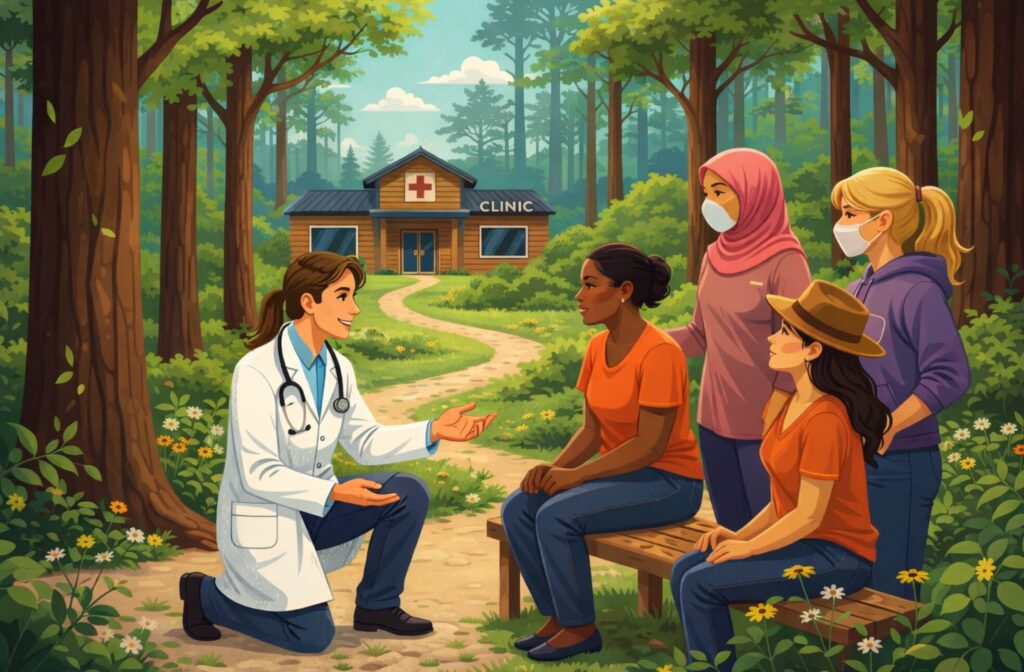
Accessing mental health care should not depend on a woman’s zip code. For many women living in rural communities, however, the path to care is far more complicated. When the nearest provider is hours away, childcare is limited, and missing work means losing income, accessing mental health services becomes less about motivation and more about structural barriers (HRSA, 2023). In the United States, mental health access is often framed as an individual responsibility (NRHA, 2022). Rural residency, in particular, is frequently discussed in terms of lifestyle or culture rather than as a key determinant of healthcare access (NRHA, 2022). Yet rural women face a whole host of challenges, including geographic isolation, provider shortages, socioeconomic strain, and heightened gender-specific mental health vulnerability (HRSA, 2023; NRHA, 2022). These challenges are reflected in outcomes: rural women experience similar or higher rates of depression and suicide compared with their urban counterparts, with particularly high risk among women facing poverty, intimate partner violence, or perinatal mental health challenges (CDC, 2022; Rural Health Information Hub, 2023). For these women, mental health access is not simply about choosing to seek care; it is a structural and equity issue.
Consider the example of a middle-aged rural mother who drives two hours to a psychiatric follow-up while coordinating childcare and sacrificing hourly wages. This scenario underscores the cumulative impact of distance, limited workforce, and competing responsibilities, highlighting the systemic barriers embedded in rural healthcare delivery (HRSA, 2023). Addressing mental health access in rural communities, therefore, requires reframing the conversation from individual behavior to health equity and system-level interventions. By acknowledging the structural determinants of care, we can better support rural women and promote equitable access to mental health services (HRSA, 2023).
Workforce shortages and fragmented care systems further complicate mental health access for rural women. Many rural communities lack specialists such as perinatal psychiatrists and trauma-informed therapists, leaving significant gaps in care for women facing pregnancy-related mental health conditions or histories of trauma (Policy Center for Maternal Mental Health, 2024). Substance use treatment programs are also limited, particularly those designed for women who need childcare support while receiving treatment. Although integrated primary care–behavioral health models have shown promise in improving outcomes and expanding access, these programs remain inconsistently implemented and underfunded in many rural regions (Rural Health Information Hub, 2023). As a result, women frequently encounter gaps between services rather than a cohesive system of care.
Beyond structural barriers, cultural factors also shape how rural women engage with mental health care. Many rural communities place a strong emphasis on self-reliance and personal resilience, which can discourage individuals from seeking formal mental health support (NRHA, 2022). Privacy concerns also play a role; in small communities where “everyone knows everyone,” women may fear that seeking counseling or psychiatric care could compromise their anonymity. As a result, mental health struggles may be minimized or interpreted as personal weakness rather than recognized as treatable medical conditions. These perceptions contribute to delayed care, making women less likely to seek help early and more likely to present when symptoms have reached a crisis level (Rural Health Information Hub, 2023; NRHA, 2022).
The COVID-19 pandemic accelerated the expansion of tele-mental health services across rural communities, offering new opportunities to address longstanding access barriers. Virtual care can reduce the burden of long travel times and partially offset provider shortages by connecting rural patients with specialists located hundreds of miles away (HRSA, 2023). For many rural women, telehealth has created a more flexible pathway to mental health support. However, important gaps remain. Broadband access remains uneven in many rural areas, digital literacy varies across populations, and maintaining privacy for virtual visits can be challenging in crowded or shared home environments (Office of the Assistant Secretary for Planning and Evaluation [ASPE], 2023; Rural Health Information Hub, 2023). While telehealth has improved access to care, it does not fully eliminate the structural inequities that continue to shape mental health outcomes in rural communities (ASPE, 2023; HRSA, 2023).
When mental health services are limited or difficult to access, the consequences for rural women and their communities can be profound. Delayed or untreated depression and anxiety often worsen over time, increasing the likelihood of crisis-level symptoms, functional impairment, and suicide risk (Centers for Disease Control and Prevention, 2022; Substance Abuse and Mental Health Services Administration, 2023). In rural communities, distance, stigma, and provider shortages can turn treatable conditions into escalating crises. Rural communities already experience disproportionately higher suicide rates compared with urban areas, reflecting both limited access to care and broader structural barriers to treatment (Centers for Disease Control and Prevention, 2022).
Untreated mental illness is also associated with increased vulnerability to substance use disorders, as individuals may turn to alcohol or drugs as coping mechanisms for unmanaged psychological distress (National Institute on Drug Abuse, 2023). The effects extend beyond the individual. Maternal mental health challenges can increase parenting stress, disrupt family stability, and influence children’s emotional and developmental outcomes, contributing to intergenerational mental health disparities (American Academy of Pediatrics, 2021). Mental health access is not just about one person; it can shape the well-being of an entire family. At the community level, inadequate mental health care is linked to reduced workforce participation, greater chronic disease burden, and broader economic strain in already resource-limited rural regions (National Rural Health Association, 2022; Health Resources and Services Administration, 2023). When mental health needs go unmet, the ripple effects are felt across families, workplaces, and communities. For these reasons, improving mental health access for rural women should be viewed not as a niche issue, but as a critical population health priority.
Improving mental health care for rural women requires moving beyond acknowledging disparities toward implementing policies that address the structural barriers limiting access to care. Expanding the behavioral health workforce through loan repayment programs and rural training pipelines can help mitigate persistent provider shortages in rural communities (Health Resources and Services Administration, 2023). At the same time, telehealth can help bridge geographic gaps in care. Still, its success depends on reimbursement and continued investment in broadband infrastructure so rural patients can reliably access virtual services (Rural Health Information Hub, 2023). Integrating behavioral health into primary care and embedding maternal mental health treatment by bringing services into settings where women already receive care (Agency for Healthcare Research and Quality, 2022). Ultimately, meaningful reform must focus on strengthening systems rather than relying on individual resilience to overcome structural barriers.
Where a woman lives should not determine whether she can access mental health care. Yet for many rural women, distance, workforce shortages, and limited infrastructure continue to shape whether support is available when it is needed most. These disparities are not the result of a lack of motivation to seek care; they reflect longstanding policy decisions, uneven workforce distribution, and gaps in health system investment (National Rural Health Association, 2022; Health Resources and Services Administration, 2023). Achieving true mental health equality will require sustained efforts to strengthen the behavioral health workforce, reduce stigma in rural communities, expand sustainable telehealth services, and address the broader socioeconomic barriers that influence health outcomes. Mental health equality will remain unfinished work until rural women are no longer navigating a system that was never built with them in mind.
References
- Agency for Healthcare Research and Quality (AHRQ). (2022). Integrating behavioral health and primary care.
- American Academy of Pediatrics (AAP). (2021). Maternal depression and its impact on child development.
- Centers for Disease Control and Prevention (CDC). (2022). Suicide rates and mental health disparities in rural populations.
- Health Resources and Services Administration (HRSA). (2023). Mental Health Professional Shortage Areas. U.S. Department of Health and Human Services.
- Office of the Assistant Secretary for Planning and Evaluation (ASPE). (2023). Broadband access and telehealth utilization disparities.
- Policy Center for Maternal Mental Health. (2024). Perinatal mental health infrastructure gaps in rural counties.
- Rural Health Information Hub. (2023). Rural mental health disparities and risk factors for women.
- National Institute on Drug Abuse (NIDA). (2023). Substance use and mental health comorbidity.
- National Rural Health Association (NRHA). (2022). Rural Mental Health Disparities: Workforce and Infrastructure Challenges.
- Substance Abuse and Mental Health Services Administration (SAMHSA). (2023). Behavioral health disparities in rural populations.
About the Authors
Lauren Wallace, MS3

Lauren Wallace is a third-year medical student at St. George’s University School of Medicine and earned her Bachelor’s degree in Cell and Molecular Biology from the University of Tennessee at Martin. She has served as student lead for her Psychiatry and Obstetrics/Gynecology core rotations and is an active member of the Gender Equity Task Force, demonstrating her dedication to advancing equitable care. Passionate about Psychiatry, Lauren volunteers for the Crisis Text Line and focuses on improving access to mental health services in underserved rural communities, a commitment rooted in her upbringing in rural Tennessee. Outside of medicine, she enjoys staying active and scuba diving with her husband.
Meghan Etsey, MS4

Meghan Etsey is a fourth year medical student from St. George’s University. She has a Bachelors of Arts in Biology and a Bachelors of Arts in Nutrition and Dietetics from Bluffton University in Bluffton, Ohio. She served as the President of the St. George’s University’s Women in Medicine chapter in St. George, Grenada where she expanded relationships with the community and worked towards educating women and helping the youth. She is also a member of the Gender Equity Task Force and Sex and Gender Health Collaborative Committees within the American Medical Women’s Association. When she is not pursuing medicine, you can find her with her friends and family on different road trips and adventures exploring the world.
Yun Weisholtz, MD-PhD

Dr. Yun Weisholtz is a physician-scientist and advisor with a deep commitment to mentorship and advancing equity in medicine. She completed her undergraduate studies at Stanford University, where she double-majored in Biological Sciences and Chemistry, and spent a year in Germany as a Fulbright Scholar. She went on to enter the MD-PhD program in Neuroscience at Harvard Medical School and MIT, where she developed her passion for research, teaching, and mentoring. Dr. Weisholtz is a Physician Advisor with MedSchoolCoach and the founder of MD-PhD Advising, a consulting practice dedicated to helping students navigate the medical school and residency application process. Outside of work, she enjoys collecting Delft pottery from the Netherlands and spending time with her family and pets.