
Authors: Meghan Etsey, Bethany Fenton, Dr. Yun Weisholtz on behalf of the Gender Equity Task Force
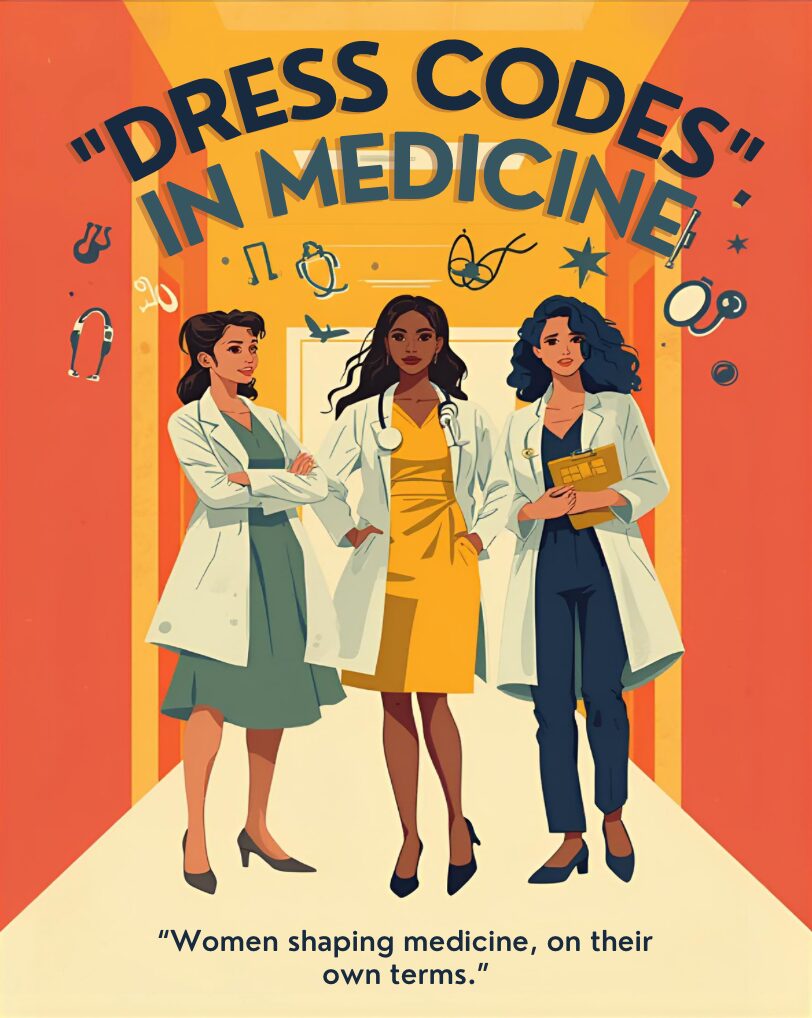
Throughout the history of medicine, attire has served as a visible marker of professionalism and authority, with the white coat symbolizing trust, expertise, and credibility (Rehman et al., 2005). Traditionally, women in medicine have adopted attire considered professional within clinical norms: blouses, slacks, skirts, or dresses, sometimes paired with a white coat, or scrubs in procedural and acute care settings. However, in today’s evolving healthcare landscape, an important question emerges: how much does what physicians wear truly influence patient perceptions, and should these preferences guide how clinicians present themselves?
A 2025 meta-analysis revealed that physician attire significantly shapes how patients perceive professionalism, trustworthiness, and communication skills (Kim et al., 2025). However, these perceptions are far from uniform. The study found that attire preferences vary across clinical settings and specialties: patients often favor casual attire with a white coat in primary care but prefer scrubs in emergency or procedural contexts. Interestingly, male physicians were perceived as more professional when wearing either business attire with a white coat or scrubs compared to female physicians dressed similarly. Since the COVID-19 pandemic, there has also been a noticeable shift toward patients preferring casual attire and scrubs, reflecting increased public awareness of hygiene and infection control (Kim et al., 2025).
Professional dress in medicine goes beyond aesthetics; it serves as a sociocultural construct that is deeply intertwined with bias. Research consistently shows that regardless of attire, female physicians are more likely than their male counterparts to be misidentified as non-physician healthcare workers and judged as less professional (Xun et al., 2021; Rehman et al., 2005; Varnado-Sullivan et al., 2019). These biases are even more pronounced for women of color, who face compounded stereotypes that further obscure their professional identity (Varnado-Sullivan et al., 2019). Collectively, these findings highlight the persistent impact of gender and racial bias on perceptions of who is deemed to “look” like a physician.
So what defines “professionalism,” and who gets to decide?
As discussed in Academic Medicine, professionalism is often framed through Eurocentric, patriarchal, and heteronormative lenses that privilege conformity over authenticity (Hunt et al., 2023). These standards may inadvertently exclude, penalize, or overburden women, gender-diverse individuals, and people of color. The policing of professional appearance begins early in training, where medical education dress codes tend to overregulate “feminine-coded” items, such as bracelets, perfume, nail polish, heel height, or certain hairstyles, while overlooking equivalent “masculine-coded” items, such as watches, cologne, or wedding bands (Ruzycki et al., 2022). This can further be seen when women go into post-graduate medical training, with Muslim women being questioned and feeling bullied while wearing hijabs in the operating room (Malik et al., 2019).
This aligns with broader research outside the medical field. Studies indicate that dress codes in educational and workplace settings often disproportionately affect women and marginalized groups under the facade of “professionalism” (Edwards & Marshall, 2020; Griffin, 2019). These policies not only perpetuate systemic discrimination but also stifle individual expression in the name of decorum. By imposing dress codes that primarily target women and marginalized individuals, institutions strengthen existing biases and undermine efforts toward inclusivity.How do we balance professionalism with authenticity, equity, and inclusion? Must our dress change depending on clinical setting, gender, race, religion, or even patients’ age and gender? We maintain that physicians achieve inclusion, safety, infection prevention, comfort, and authenticity by wearing what aligns with their own professional identity. Framing dress codes around what patients might prefer gives precedence to the comfort of hypothetical patients over preserving the rights of actual physicians. Physician attire may influence patient perception, but there is no evidence establishing a causal link between physician attire and adherence to medical recommendations.
Dress codes must evolve to reflect modern realities and the diversity of those practicing medicine. As the field shifts toward a more inclusive understanding of professionalism, medical institutions should:
- Conduct audits of dress code policies through a gender and equity lens.
- The dress code should avoid defining acceptable attire in gendered terms (e.g., ‘for men’ vs. ‘for women’) and instead apply neutrally to all.
- Do not enforce Eurocentric standards.
- Include diverse voices, particularly women and underrepresented physicians, in the policy-making process.
- Educate faculty and staff on implicit bias in perceptions of professionalism.
- Normalize attire diversity as part of a broader effort to humanize and modernize medicine.
The future of medicine depends not on uniformity, but on authenticity, equity, and belonging.
References
Edwards, T. K., & Marshall, C. (2020). Undressing policy: A critical analysis of North Carolina (USA) public school dress codes. Gender and Education, 32(6), 732–750. https://doi.org/10.1080/09540253.2018.1503234
Griffin, C. (2019, July 3). How natural Black hair at work became a civil rights issue. JSTOR Daily.https://daily.jstor.org/how-natural-black-hair-at-work-became-a-civil-rights-issue/
Hunt, L. M., Bhatt, J., Park, E. R., et al. (2023). The problem and power of professionalism: A call for a new way forward. Academic Medicine, 98(11S), S12–S15. https://journals.lww.com/academicmedicine/fulltext/2023/11001/the_problem_and_power_of_professionalism__a.8.aspx
Kim, J., Ba, Y., Kim, J. Y., & Youn, B. Y. (2025). Patient perception of physician attire: A systematic review update. BMJ Open, 15(8), e100824. https://doi.org/10.1136/bmjopen-2025-100824
Malik, A., Qureshi, H., Abdul-Razakq, H., & others. (2019). “I decided not to go into surgery due to dress code”: A cross-sectional study within the UK investigating experiences of female Muslim medical health professionals on bare below the elbows (BBE) policy and wearing headscarves (hijabs) in theatre. BMJ Open, 9(3), e019954. https://doi.org/10.1136/bmjopen-2017-019954
Rehman, S. U., Nietert, P. J., Cope, D. W., & Kilpatrick, A. O. (2005). What to wear today? Effect of doctor’s attire on the trust and confidence of patients. The American Journal of Medicine, 118(11), 1279–1286. https://doi.org/10.1016/j.amjmed.2005.04.026
Ruzycki, S. M., Daodu, O., Hernandez, S., & Lithgow, K. C. (2022). The contribution of undergraduate medical education dress codes to systemic discrimination: A critical policy analysis. Medical Education, 56(9), 949–957. https://doi.org/10.1111/medu.14854
Varnado-Sullivan, P., Larzelere, M., Solek, K., et al. (2019). The impact of physician demographic characteristics on perceptions of their attire. Family Medicine, 51(9), 737–741. https://doi.org/10.22454/FamMed.2019.650493
Xun, H., Chen, J., Sun, A. H., et al. (2021). Public perceptions of physician attire and professionalism in the US. JAMA Network Open, 4(7), e2117779. https://doi.org/10.1001/jamanetworkopen.2021.17779
About the Authors
Meghan Etsey, MS4

Meghan Etsey is a fourth year medical student from St. George’s University. She has a Bachelors of Arts in Biology and a Bachelors of Arts in Nutrition and Dietetics from Bluffton University in Bluffton, Ohio. She served as the President of the St. George’s University’s Women in Medicine chapter in St. George, Grenada where she expanded relationships with the community and worked towards educating women and helping the youth. She is also a member of the Gender Equity Task Force and Sex and Gender Health Collaborative Committees within the American Medical Women’s Association. When she is not pursuing medicine, you can find her with her friends and family on different road trips and adventures exploring the world.
Bethany Fenton, MS4

Bethany Fenton is a fourth year medical student from St. George’s University. She holds a Master of Science in Nutritional Sciences from the University of Kentucky and received a Bachelor of Science in Dietetics from Eastern Kentucky University. She worked as a critical care dietitian for ten years prior to pursuing medical school. She is also a member of the Gender Equity Task Force and Nutrition and Medicine Working Group Committees within the American Medical Women’s Association. When she’s not studying, you can find her spending time with her husband and cats, using her Holga camera for experimental photography, lifting weights at the gym, playing board games, and reading science fiction novels.

Dr. Yun Weisholtz is a physician-scientist and advisor with a deep commitment to mentorship and advancing equity in medicine. She completed her undergraduate studies at Stanford University, where she double-majored in Biological Sciences and Chemistry, and spent a year in Germany as a Fulbright Scholar. She went on to enter the MD-PhD program in Neuroscience at Harvard Medical School and MIT, where she developed her passion for research, teaching, and mentoring. Dr. Weisholtz is a Physician Advisor with MedSchoolCoach and the founder of MD-PhD Advising, a consulting practice dedicated to helping students navigate the medical school and residency application process. Outside of work, she enjoys collecting Delft pottery from the Netherlands and spending time with her family and pets.