
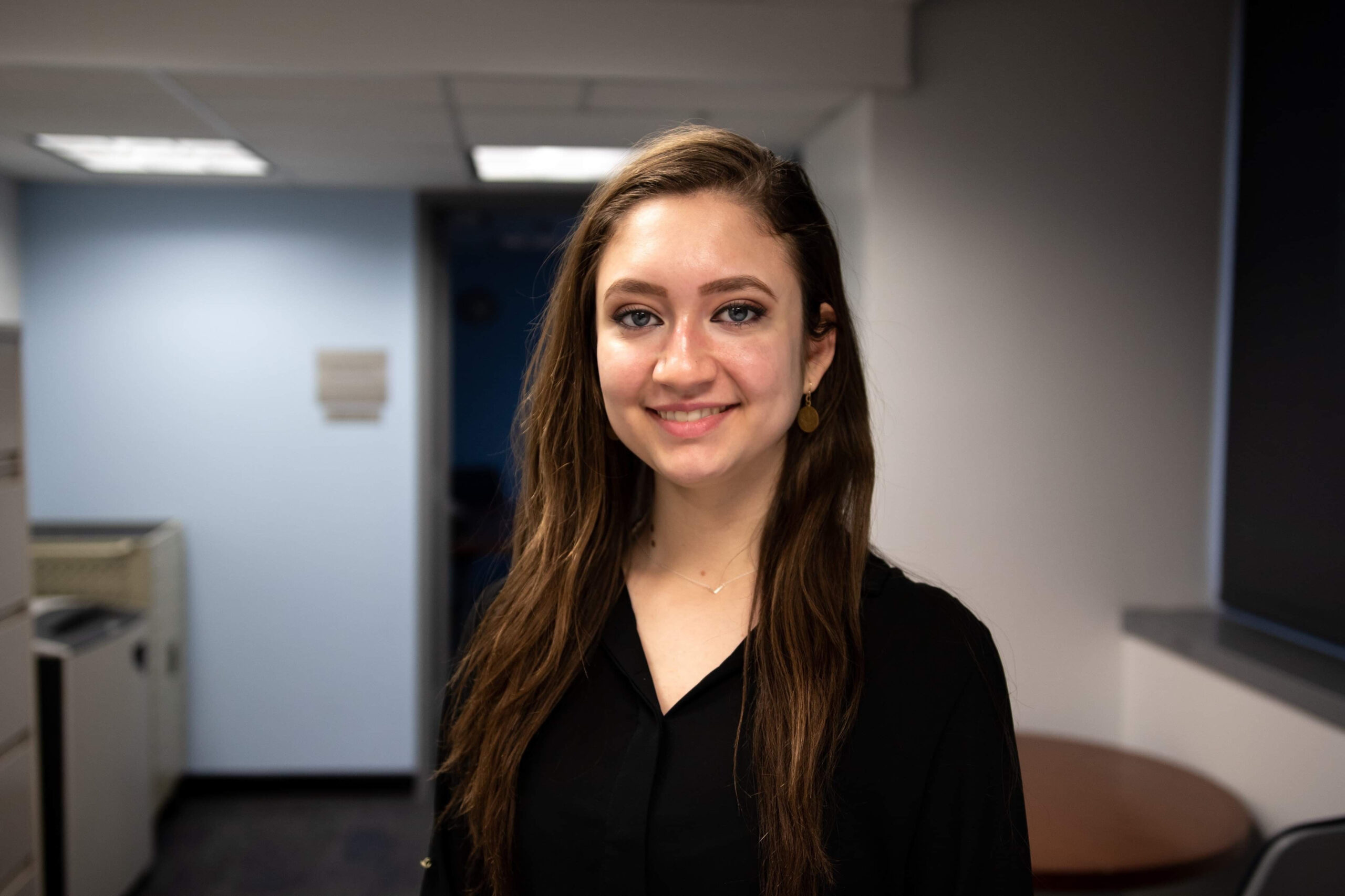
Follow Sophia on Instagram at @sophiasalingaros and Facebook at “Sophia Salingaros.”
1. What is your background in both dance and medicine? Why did you decide to pursue these two disciplines?
I started learning ballet when I was 5 and Bharatanatyam (an Indian classical dance style) when I was 9. Despite not knowing much about Indian culture at the time, I was drawn to the beauty and complexity of the style. My mother is a doctor, and I was going through the traditional pre-med route throughout college, though my love for dance continued to grow. Up until I applied for medical school, I was torn between dance and pursuing a medical career. Ultimately, I am determined to prove that you don’t have to give up what you love to pursue a career such as medicine! I performed nationally and internationally during my first year at Weill Cornell and am planning to continue pursing my two passions and exploring how they can intersect.
2. When was the first time you performed, and what part of that experience do you still carry with you?
My first performance was at the Diwali festival in my hometown of San Antonio, Texas. I was mesmerized by the costumes, jewelry, and makeup that we got to wear. I remember being so young that I had no concept of stage fright or critical judgement of my dance. I like to hold onto the childhood innocence and pure joy of movement that I experienced that day when I perform now as a professional dancer.
3. What are you working on now that combines your love of dance and medicine?How do you blend your work in these two fields?
I’m very interested in using the language of Indian classical dance to convey contemporary messages related to healthcare. For example, I’ve worked with Aseemkala initiatives to create pieces that discuss a patient’s right to DNR (Do Not Resuscitate) orders. I’ve additionally created work with IndianRaga attempting to destigmatize mental health issues. I feel art is a unique and powerful tool to send a message to an audience that no amount of data, publications or lectures can.
4. What is one concluding piece of advice you would share for those individuals who aspire to merge their passions for health and the performing arts?
I want to encourage every performing artist not to be overwhelmed by the thought of pursuing an extremely rigorous path – like medicine – and assume that there is no time to pursue artistic passions. There are many doctor/artists that have come before us, and with determination (and time management) I believe it is possible to maintain a professional level in both medicine and art. In fact, I think they complement each other; art makes you a more humane doctor, and medicine makes you a more introspective and analytical artist.
Dance Photos Credit: Chandrasekhar Panchavati
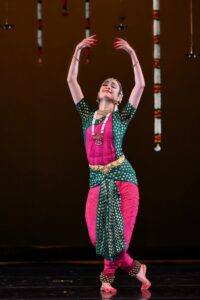


1. What is your background in both dance and medicine? Why did you decide to pursue these two disciplines? (This is more of an introduction, so feel free to expand on these topics!)
While I have trained in multiple styles of dance, ballet was always my favorite. According to my mom, they started me in ballet at the age of 3 because I was “always bouncing around the house.” What was initially intended as an outlet for my energy soon became an obsession. Starting in grade school, I competed in the Youth American Grand Prix, qualifying for the finals in NYC seven consecutive years. During high school, I was among several students from around the world invited to attend the year-round program at the Rock School for Dance Education in Philadelphia and subsequently went on to dance professionally. Ultimately, my ballet career was cut short due to injuries. I returned to school to study nutrition after seeing the widespread nutritional concerns found in the dance community. After working as a registered dietitian for a few years, I decided to pursue medical school to not only better myself, but to simultaneously be able to better contribute to my community. I am currently finishing my 3rd year of medical school.
2. When was the first time you performed, and what part of that experience do you still carry with you?
I technically believe my first performance was a recital dance titled “Ants in My Pants” at the age of 3 at a studio in Decatur, IL. Slight embarrassment is perhaps the only thing I carry with me from that performance, and I hope there’s no video documentation anywhere. The first performance where I felt as though I may have a chance at dancing professionally was when I performed the Blue Bird variation from Sleeping Beauty at age 11 in the Youth American Grand Prix and received the Hope Award. I trained daily for several months for the performance that lasted only a few short minutes. This taught me the value of dedication and commitment.
3. Such creative journeys often face great challenges and successes. What event(s) inspired or challenged you personally to pursue dance and incorporate that practice into your medical training?
Through experiencing several injuries during my time dancing and seeing the role of nutrition on performance, I have developed a special interest in sports medicine and nutrition. I feel as though my prior experiences give me an advantage into understanding the unique medical needs of dancers and other female athletes, who I would love to work with after medical school.
4. What is one concluding piece of advice you would share for those individuals who aspire to merge their passions for health and the performing arts?
Upon entering medical school, I was under the false impression that the sciences and the arts were two very distinct entities. I soon realized that not only can the two coexist, but they thrive together. I would encourage any performing artist who is interested to pursue a health career. From first-hand experience, I know that we need more health professionals who truly understand the demands, pressures, and needs of performing artists.


1. What is your background in both dance and medicine? Why did you decide to pursue these two disciplines?
I professionally trained in Indian classical dance, Bharatnatyam, since the age of 5 years old. My first performance was on the grounds of the Hindu Temple in Hockessin, Delaware, my hometown. I later on learned other forms of classical indian dance from Kuchipudi to Kathak, as well as popular bollywood dance. I performed throughout various arenas through the tri-state area as a solo dance choreographer from the American Telugu Association national convention events, and pageants including Jewel of India in Delaware. I later joined the Delaware Kamaal Dance Team at the University of Delaware. Through this collegiate dance team we nationally competed at bollywood dance competitions throughout the United States, charity fundraisers, and other collegiate events in Delaware. Our team won several awards. I danced on this team for four years prior to attending medical school. During medical school I joined the Indian Students Association and performed at cultural events on the island of Dominica. Following medical school I began a personal blog about dance and medicine on a personal website. (This blog is private until I am a full fledged physician!) I wrote about several topics from movement therapy, to kinesthetic empathy, yoga, and mindfulness. I was fascinated about the link between dance and health as a growing physician. I wanted to be able to share my knowledge with others and began expanding my knowledge in yoga. I authored a publication in the New York Academy of Family Physicians, Family Medicine Journal called the “Exploration of Indian Arts and Movement Therapy.”
Excerpt from my blog: (www.varudhinireddy.com)
“Through my own experiences and years of performing up until the end of college, I have experienced dance and art as a way to channel my energy into the environment for positive transformation. Losing yourself in front of thousands of people is an incredibly gratifying feeling. Likewise, any member of the audience may also be able to lose themselves in the moment by taking part in the performance – simply by creating its own meaning, feeling, or sense of awareness to himself or herself. Reaching this level of new consciousness by either performer or observer is an example of the exchange of ideas, feelings, and knowledge without speaking a single word. This is what it means to be transformed by art.”
2. When was the first time you performed, and what part of that experience do you still carry with you?
The first time I performed was as a young girl, only 5-7 years old, in front of a large audience at the Hindu Temple of Delaware. It was my first time to wear “ghungroo” or musical anklets that are tied around the anklets of Indian classical dancers to intensify their rhythmic movements and add to the overall visual and musical performance. I was so excited I got to wear these anklets. I did not care about being shy or performing in front of an audience.
3. Such creative journeys often face great challenges and successes. What event(s) inspired or challenged you personally to pursue dance and incorporate that practice into your medical training?
Excerpt from my blog: www.varudhinireddy.com
“Creative power can be thought of directing the flow of life force energy to manifest something new, for example your dreams or goals. For this reason, not only may we improve our health through practicing yoga, but perhaps harness our dormant creative energies to create something new or redirect our lives in a positive direction. Have you ever wanted to change your life or manifest your dreams? Meditation, yoga, or dance, may be some proven tools throughout time and science to help you. I encourage others to explore the many health benefits movement meditation has to offer themselves and others in order to unleash their individual power or “kundalini.” I encourage others to explore the performance arts to channel their own creativity into the world.”
4. How do you blend your work in dance and in medicine? What’s one piece of advice you can share for aspiring artist-physicians?
Excerpt from my blog: www.varudhinireddy.com
“For millennials, cultures have used the display of movement or dance to connect others…Performances were used to transmit themes, issues, and feelings to the audience. Empathy is ability to share feelings with another. What can we do to increase kinesthetic empathy between ourselves and others? What kind of impact will this have on our relationship with ourselves and others? Increasing one’s ability to intuit the feelings of others through movement
may increase our ability to connect with each other. I encourage others to explore any type of movement or dance to bring richness to their own life and to that of others.”



What is your background in dance and medicine, and why did you decide to pursue these two disciplines?
My first connection with anything that I can remember far back is that of movement and music, and that’s part of the reason why my organization today is called “Making Moves…” This finally makes sense 38 years later because when I first got introduced to the concept of movement and/or dance, it wasn’t necessarily through the idea of the actual physical part of dancing – it was really the connection between the moves and the music, which is something that everyone can own for themselves, and how I got introduced to dance, artistry, and theater. That eventually became my artistic angle in life that always gave me a certain joy. Throughout college and even while I was at medical school at UCLA, I was doing shows and involved in acting, so I continued and pursued that artistic mindset. Throughout that time period, I just kept adding tools, whether it was old school hip hop in college or samba/Latin ballroom in Miami, and just added things as they came along. I then got a lot more into the choreography aspect and performed with lots of teams, which was such a joy. My medical pathway really came about somewhat automatically – it came simply from the idea that I wanted to help people, it was always something that I wanted to do. I went to USC in a direct-med program for undergrad, then attended UCLA for medical school. And then oncology found me, in a sense through movement. I was playing basketball at the UCLA Wooden Center and was inspired by a conversation with a friend who was a radiation oncologist as well as an actor. The idea of interweaving these two seemingly separate identities intrigued me, and so I decided to explore oncology. I ended up really loving it and left UCLA as a radiation oncologist and began practicing in Miami, which seemed fitting since I spoke fluent Spanish and Portuguese and was really interested in global cultures. There I was able to have some liberty to explore music and choreography more in depth, alongside my growing medical practice. With Miami’s local cultural interest in music and dance and my urge to combine my two loves of dance and medicine, I decided to start moving around with my patients. That was really the origin of Making Moves Universal, where the benefits of dance and movement for patients are not only physical but also emotional/mental, as well as just providing the joy and openness of dancing and moving with a group of people. This combination of health/wellness alongside artistry/movement really does provide a new perspective on the provider-patient relationship that simply can’t be achieved in a conventional doctor’s office.
Was there any specific event that inspired you personally to incorporate dance into your medical practice and combine these two disciplines?
You would have to start from the idea that when I was in medical school, at that time it was a bit foreign to delve out of the practice of committing yourself to a certain sole entity. At the time I thought, “But what if I like to move? I want to somehow have both in my life.” That was my big dilemma inside: fear of having to choose and not being able to pursue both of my passions. It was to the point where when I graduated in 2013, I was contemplating doing radiation oncology part-time, and using the rest of my time to focus on artistic endeavors. But Miami afforded me an interesting opportunity, so I decided to go with it and see what happened. I got to explore myself as an “artist” by adding Latin dance to the mix and then learning how to fuse it with my existing stylistic vocabulary. So there really was no specific incident in time, but you could say that the incident was a calling from within. We all think that these “incidents” are coming from the outside, but sometimes we’re asking for it ourselves and we have to listen to that calling to inform our actions. From there I had a conversation with the clinic I was working in at the time, expressing that perhaps putting me in the clinic 5 days a week wouldn’t be as efficient as trying some different all-around care strategies. It was a difficult conversation to initiate, but that was what inspired my organization today and now I am just trying to be as efficient with my time in and out of clinic as possible and help both of those routes grow.
What is your organization, Making Moves Universal? What does it do to incorporate dance and movement into the healing process?
Making Moves Universal is an international movement combining all fundamental types of functional movement with a variety of esoteric music to improve life situations of those with chronic illness – emotional, mental, spiritual, physical… essentially empowering us to engage our own inner resources to combat whatever we have within. More specifically, it’s really just using music and movement as a way for us to combine passion and profession, and in a sense help us conquer our own illnesses. This the foundation from which we started. What I did was group patients together who had that same intention in mind, and started tapping into what every person resonated with sonically through the language of movement. Then it was breaking down these functional movements, using my medical background to hone in on certain moves and repetitions that would benefit these patients that most. So I couldn’t tell you if it’s the movement itself, if it’s the actual functional enhancement in people’s ways of moving where clearly there is a sort of body-mind interaction, or whether it’s just the pure joy of the song and being in an environment with other people there… which one of those is going to be most prominent each patient yet. But I can say that I am willing to explore that, and I think the best way for me to explore that is through this work.
Definitely! And in some ways, that’s really what our Task Force is all about – the two entities of medicine/wellness and art/dance can often seem very different but in reality they are so intertwined. Dance can really inform so much about our human experience.
Absolutely. That human experience, patient experience is so important, and at the end of the day we are always asking how we can improve that patient experience. And clearly, it is going to be engaging them on things that aren’t necessarily tangible, such as the way people feel, things that aren’t measurable using our traditional metrics. But the patient experience is something that is very common right now, and the basis of value-based medicine. There is something to be learned from the wellness community. So many cancer patients that I see and my colleagues see come in and want this extra thing, this part of the care that seems to be missing. And if it’s not emphasized in the healthcare system, it’s tough because then it’s hard to get healthcare workers out of that rigid mindset. When it comes to healing though, it seems that we are kind of moving toward a place in which people are asking for that additional value added into their experiences in medicine. I’m excited to see that continued growth.
Switching gears a bit, I am here with the American Medical Women’s Association. You mentioned something previously that I thought was really intriguing, which was that movement and dance can be considered “an expression of the divine or feminine that is needed in healthcare today.” Could you perhaps elaborate a bit more on that sentiment?
Great question! Essentially, whether it’s the yin and the yang or the feminine and the masculine, they are all part of the one. We’ve tended to view more of our issues on the superficial as being more female/male issues. But in a higher sense, we are pulling for the leaders of the world to show a bit more of these rounded values of flexibility, understanding, empathy in addition to our conventional values of discipline and direction. We’re all a part of both in a sense, so movement and dance can be seen as an expression of this needed alternative angle. That’s what healthcare is calling for. We’re trying to bring those values of joy and passion more consciously into the healthcare space. That’s why it’s an honor to be interviewed by you and your organization, sitting here as a straight male, because I’d definitely love to see more of that balance and perspective shift in our healthcare landscape today, and I’m grateful to be someone who can play a role in advocating for that.
As one final question, as someone who has successfully navigated their career and found a deep and impactful way to incorporate dance with medicine, what is a piece of advice that you might share with individuals who are aspiring to merge their passions for health and the performing arts, or find it difficult to upkeep their passions as they make their way through their medical journeys?
This is a phenomenal question, because on the one side I will always say that there is the reality of the grit that you need to pull through in any kind of healthcare career. The journey is tough sometimes and is going to require some periods of these singular focuses. But I think my biggest advice is to tap into your reason why. The notions of wanting to heal people and wanting to be a dancer don’t have to be mutually exclusive. Just by being yourself and living your authentic truth, you’re going to bring your best to the table no matter what it is or how specific your role is. With this, you’ll be able to engage both sides organically in everything that you do. It’s hard to sustain doing something based on what you think you like; it’s much easier to do something when you know that it’s true to your heart.


Photo Credit: CAFP
Follow Dr. Fu on Instagram and Twitter at @theimprovdoc.
1. When was the first time you performed improv on stage? What part of that experience do you still carry with you?
The first time I “officially” performed improv on stage was in 2009, in a show at Jet City Improv called, “This Improvised Life”, which was inspired by the NPR program “This American Life”. We had an Ira-Glass-esque host, a theme for the evening, and we improvised stories in the style of what you’d hear on that NPR program – ie, really human stories. What I carry from that experience is a lot of gratitude, and a feeling of awe. At the time I was cast, I had only been studying improv for a year, so I was such a newbie, and very much in awe of my talented castmates, who were all very experienced improvisers. It was my first time being cast in an improv show, so I felt immense gratitude for the director, Ian Schempp, trusting me to rise to the occasion, and for my castmates, who supported, encouraged, and guided me throughout the show. When you’re making up stories out of nothing, mistakes are inevitable, so to have the experience of being supported and saved by a group of people who “have your back”, no matter what — it embodied the power of improv for me, and reinforced my belief in the work and my desire to keep going. In that show, I experienced for the first time that thrilling sensation of discovering and creating stories in real time, with my castmates and the audience. There was such an incredible feeling of trust, and of presence — living in that moment, where everyone in the room is experiencing a revelation at exactly the same time as a story unfolds … it was an amazing sensation, to experience the powerful bonding human experience of live improvised theatre.
2. Such creative journeys often face great challenges and successes. What event or series of events inspired or challenged you personally to pursue your work addressing the need for improvisation in medical training?
I’ve always been interested in communication, particularly in the healthcare context; one of my undergraduate research projects was about the use of medical jargon in patient education materials. And I’ve always integrated the arts in the healthcare world: throughout high school, college, and during medical school, I performed music at nursing homes, retirement homes, and hospitals. But the intersection of improv with medicine for me was (like many things in life) an unexpected circumstance of timing. My original interest in improv theatre was purely for fun and art; I didn’t know there was such a thing as “applied improv” at the time I started taking improv classes in 2007, during my chief resident year. I was still doing performance improv by the time I started my position as faculty in a family medicine residency program, and my improv and medical worlds were separate.
But in 2011, I was diagnosed with vulvar neoplasia. I met with two different gynecologic oncologists, and I had tremendously different experiences in those encounters, because of the differences in communication. The oncologist I ultimately ended up seeing (for the next ten years!) was empathic, present, responsive, and articulate — his communication and humanity were exceptional. I think it’s fairly common for different clinicians to have different “bedside manner” styles, and of course I had learned and taught communication skills in medical education. But because I’d been doing improv for a few years at that point, I experienced these contrasting communication styles through the lens of improvisational theory and practice. The clinician who communicated so empathically and effectively was embodying the skills taught and practiced in improv. So my medical diagnosis was also in some ways a gift, because it led to a “light bulb moment” of seeing connections between improv and medicine, seeing it from both the patient and the physician side. As I continued my work in medical education and in improv, I became more convinced that improv approaches would be powerful, enjoyable, efficient, and effective ways to teach communication skills and empathy in the context of medicine, addressing challenges such as teamwork, burnout, difficult conversations, interprofessional collaborations, and many others. I was extremely fortunate to find a mentor, Prof. Katie Watson, at Northwestern Feinberg School of Medicine, who was already teaching improv to medical students. She generously worked with me to hone my skills, so that we could deepen the understanding and potential of what medical improv could play in medical / clinical education. As my work in medical improv has developed, I’ve become better able to identify the specific elements that made my wonderful oncologist’s communication so compelling, so I can develop improv curricula that give those exact skills to my residents, students, and colleagues.
As a clinician and educator, I’ve felt humbled and empowered by the communication skills that improv has given me. I’m able to build stronger healing relationships with patients, work more effectively on teams, navigate tricky conversations with a more robust toolkit, give more effective feedback, and — perhaps most importantly? — it’s significantly improved my wellbeing and given me a healthier perspective on life. In the last few years, I’ve also had challenging experiences while sitting in the clinic room or hospital as a family member or friend, and these experiences have reinforced the importance of enriching medical communication with the heart and skills of improvisation.
3. How do you blend and balance your work in Improv and in medicine? What’s one piece of advice you can share for those aspiring artist-physicians?
Blending and balancing is an ongoing process. I think of these as three different “buckets” in my life: medicine, performance improv, and medical improv. Although they overlap, they are each distinct activities, and I believe that actively practicing each of them makes me better at all of them. That said, there’s only so many hours in a day! And in my overall list of priorities, family and friends are the most important things of all. (And my dog 🙂 ) So I’ve had to be very clear with myself about priorities and boundaries, and make tough choices about commitments. I can’t do all the things I want to do, and that’s got to be okay. There was a time when I was working full time doing clinical & academic medicine, with a heavy call schedule, then coming home and either working on medical improv or rehearsing and performing improv, and I was just exhausted. It was not sustainable … AND yet it was also absolutely what I needed to do for a while to build a foundation (financial and experiential) upon which I have been able to grow. Since then, my work has been a combination of multiple part-time commitments. I have had to think creatively about how to structure my life, and it’s been challenging — logistically, financially, emotionally, philosophically — because I’m going off the “beaten path” of the “typical” medical professional career. I am always learning more about how to prioritize, make educated decisions, and invest my time and efforts in a long-term plan, with willingness to flex and change with circumstances. It’s challenging, and it’s also exciting and fulfilling.
My advice for aspiring artist-physicians would be to realize that the balance between art and work may not be found within one day, or within one week; it may balance out over months or years. Regardless, any effort put into your art will stay with you; nothing is lost. It just takes time. Plan your finances widely. Spend time really getting to know yourself, your values, and priorities, and make your decisions based on that. Practicing both art and medicine can be exhausting and also invigorating; I’m a better physician and person because I am still doing art. Don’t let go of your art, because it’s who you are. We can’t “have it all”, but it’s not about having it all, it’s not about being comprehensive. It’s about being selective. Choose that which is most important to you, and your life will become a unique shape that is an artistic creation all your own. Your balance/blend of art and medicine will look different from anybody else’s. Treat your life as the work of art that it is. Okay, that’s more than one piece of advice. 🙂

Photo Credits: Jet City Improv

Photo Credits: Todd Gardiner

Photo Credits: Justin Triemstra

1. What is your background in both dance and medicine? Why did you decide to pursue these two disciplines?
I practice primary care sports medicine with a focus in dance medicine. I grew up dancing since I was 4 years old and love the arts. As I became a more advanced dancer experiencing injuries, I found that doctors often didn’t understand the demands of my sport which limited my care and ability to return to my craft. I wanted to bridge that gap as a physician to help dancers get back to dancing when injured. I also am passionate about preventative medicine and mental health care for dancers to help keep dancers healthy “head to toe” and to prevent injuries before they occur.
2. When was the first time you performed, and what part of that experience do you still carry with you?
I was a 4 or 5 year old baby swan in our studio’s production of “Swan Lake.” My class was all very proud to be on the stage and I personally had practiced every step and pose daily (many of my non-dance pictures that year and even Christmas card is in a “swan” pose). During our performance, one little girl got a laugh shaking her booty at the front of the stage while the rest of us, unaware, were focused on our choreography. All these little dancers just heard the eruption of laughter and the stage deteriorated into a mass of crying little girls, scattering in all directions looking for their parents. Definitely a memorable performance!
3. Such creative journeys often face great challenges and successes. What event(s) inspired or challenged you personally to pursue dance and incorporate that practice into your medical training?
As every dancer can relate, I too faced several challenges while dancing. I had an ankle injury where I was told “just don’t dance en pointe” from the doctor I saw. I was once told “if you’re still having your period, you’re not working hard enough” from a teacher [NOTE: this is 100% unhealthy and incorrect advice]. I got so focused on the perfection of my dancing, my body, building my resume etc. that I often lost sight of the joy of why dancers choose to dance. Injuries, mental health, body image issues—most of us have been there. I know how frustrating it can be when you’re needing help and guidance and for someone to minimize your fears/frustrations without meaningful solutions. I see those same fears and frustrations in the dancers I treat each day along with the passion and joy that keeps them focused on their craft. It is my goal to help them navigate their health to experience the joy without the suffering for short term success, long term careers, and a lifetime of health.
4. What are you working on now that combines your love of dance and medicine? How do you blend your work in these two fields?
I work closely with the Oklahoma City Ballet and the University of Oklahoma Dance Department which helps me blend dance and medicine. I try to take classes when I can to stay close to the technique and demands these artists experience, in order to better help care for them. I recently did a ballroom dancing competition locally for our city’s chamber of commerce which was fun to dive back into training and performing!
5. What is one concluding piece of advice you would share for those individuals who aspire to merge their passions for health and the performing arts?
We are all gifted with different talents and passions. The most freeing thing for me was realizing that what we do with those gifts can look any way we want them to look and that there is no specific way to “be successful.” I love dancing but I am no professional. I love science but I’m no world renowned researcher. I love caring for people but I’m no Mother Theresa. We often tend to focus on what we aren’t vs. what we are. I can love all those things and marry them into a life and career I love that fulfills me, which is what I have been so fortunate to do. Look at what you enjoy and the gifts you have. If you’re having trouble figuring out how to make them work together, write out your goals and dreams and then sit when them for a while. Sometimes the ways to connect them are clear. Sometimes you are forging a new path. Reach out to people you admire in the fields that interest you and ask for help. You’d be surprised how willing people are to help you get to where you want to be!
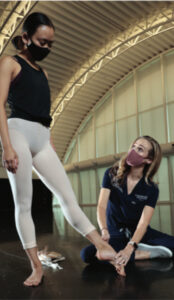
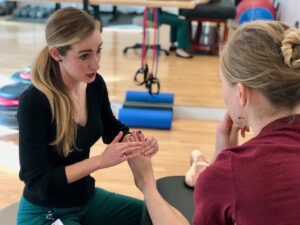
Dr. Megan Meier examines Amy Potter, Oklahoma City Ballet principal dancer, in Mercy’s clinic at the ballet.
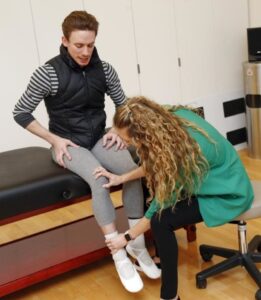
Photo Credits to McCarthy Visuals
Follow Angie on Instagram at dancingthrupa_s!
Hello everyone! My name is Angie Huang and I am a second year physician assistant (PA) student at the University of Southern California (USC). I grew up in Newport Beach, CA but I lived in Hsinchu, Taiwan for the first 5 years of my life. At 3 years old, I started taking ballet lessons at a local dance studio in Hsinchu, Taiwan. Then, when I moved to Southern California I continued ballet and trained in jazz, hip hop, and lyrical. In high school, I did competitive dance and cheer and song. During my undergraduate career at Northeastern University, I was a dancer and choreographer in the Northeastern University Dance Company (NUDANCO). I mainly choreographed hip hop. It was a great way to destress and have a group of friends with the same interest.
I grew up witnessing both of my physician grandfathers helping their small communities in Taiwan. My experiences volunteering in their clinics as a young child is the catalyst that ignited my desire to become a physician assistant. Therefore, I was a health science major with the physician assistant career in mind. During my undergraduate and postgraduate years, I worked as a clinical assistant in pediatric otolaryngology and a medical assistant in dermatology. I was a two-time PA school applicant. I decided to pursue both dance and medicine because they both have a way of helping people. Further, dance has been by my side through my journey to becoming a physician assistant. I would not be who I am today without both dance and medicine.
The first time I performed was when I was 3 years old in Hsinchu, Taiwan. We performed a traditional Taiwanese dance with ballet influences. I remembered I was nervous before going on stage but while I was on stage, I felt energized from the audience and I could not stop smiling. I enjoyed being on stage and sharing it with my friends from dance class. I still carry that nervousness every time I go on stage but now I know not to be scared and to always enjoy it!
As a mentor in the Northeastern DREAM Program, I witnessed many children, from kindergarten to high school, that were unaware of nutrition and exercise. The DREAM Program allows college students to mentor children of all ages from subsidized housing. My mentee was unfamiliar with other types of food besides fast food. I was her mentor for the full duration I attended Northeastern University. I wanted to show my mentee and the other DREAM kids that exercise can be fun and eating healthy does not have to be difficult. I wanted to expose them to what healthy living looks like so I started with my first passion, which was dance.
I utilize dance as a way to destress and exercise during my pre-physician assistant career and physician assistant training. Dance helps me forget about my challenges for the day and allows me to be in my own world with the music. For my volunteer experiences leading up to physician assistant (PA) school, I combined both my passions of medicine and dance. I volunteered with Flying Samaritans where I traveled to Tijuana, Mexico once a month with a cohort from California State University Long Beach to provide basic primary care for the local community. We would set up a makeshift clinic in a trailer which included a pharmacy and registration. While the children were waiting for their turn to see the provider, I would conduct a mini dance class in the common area with a warm up, dance combination, and freeze dance. It warmed my heart to see their joy and smiles. I did something similar with after school programs including Northeastern DREAM Mentoring Program, Girls Inc., and the Boys and Girls Club. In PA school, I taught 45-minute dance classes at a local park for my classmates. The dance classes included a warm up and a dance combination. It was a way for all of us to decompress, enjoy the outdoors, and laugh with each other. As a future healthcare provider, I hope to continue bringing smiles by combining dance and medicine.
My one piece of advice for aspiring artist-PAs is to not be afraid to combine and integrate both disciplines. It may have not been done before at your practice or school but you will never know the potential for success until you try.


Photo Credits to the photographers of the Moscow International Ballet Competition
Follow Miko on Instagram and Twitter at @mikofogarty. Follow Miko on Youtube at Miko Fogarty.
I started ballet when I was four years old and started competing at international ballet competitions by the time I was nine years old. After my 6th grade year, I decided to switch to online academic school to be able to accommodate my training and traveling schedule for ballet. I was fortunate to have been featured in a ballet documentary called “First Position”, where I was followed through the ups and downs of participating in a major ballet competition. From there, I started to perform all around the world and received a professional contract with the Birmingham Royal Ballet at seventeen years old. As much as I was finding success in ballet, I was dealing with different injuries and started to gain an interest in careers outside of dance. This is where medicine comes in. When I was injured, I started discovering how the tendons, muscles, and bones of the human body allowed me to dance and found it fascinating. I had an urge to learn more and so I decided to attend college to start my new chapter. I first started out at a community college to have a smoother transition away from my professional ballet career and then after two years, transferred to the University of California, Berkeley. This past summer, I graduated with honors and have decided to take a gap year to focus on my applications to medical and graduate programs.
The first time I performed on stage was when I was five years old! I don’t remember too much about this experience but I do remember being covered in glitter and receiving a lollipop afterward. To this day, I still love many sparkly items and also like rewarding myself with a treat after I have accomplished a goal or finished a difficult task.
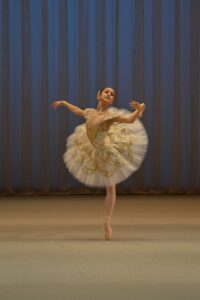
Taking the leap from my career of ballet and the performing arts to medicine and research was definitely a challenge. I had worked for over 15 years to build up my career in ballet so leaving all of that behind was a huge decision for me to make. Yet, this was not the most difficult part for me. What was the most challenging for me was to open up to everyone in my life about my career change. I had identified with ballet for so long and had built up a pretty large group of supporters, so coming out about my career change was the most difficult part. It took me nearly two whole years to open up. Yet, what surprised me during this transition was how understanding and supportive people were with my decision, which I am truly thankful for. I hope to be a vessel of support for those who may be going through similar transitions in their careers and lives. I hope to use many of the lessons and experiences that I have gathered in ballet to help me along with my next chapter in life.
Part of the reason why leaving ballet behind was so difficult for me was because I thought I would never be able to experience much ballet after my career change. Yet this was assumption was not necessarily true. I have been teaching and coaching the next generation of dancers on weekends and have absolutely loved doing so. I also try to make time to watch and support the dancers of the closest ballet company to me which happens to be the San Francisco Ballet. I will always keep the memories, people, and experiences that I have been fortunate to have in ballet, very close to my heart. One piece of advice that I would share for those aspiring to be artist-science students would be to manage time very wisely, because if you can do so, then you can definitely pursue both!


Follow Dr. Iafrate on Instagram at @columbiadancemedicine and @julezlouisa and Twitter at @thenewdrj!
1. What is your background in both dance and medicine? Why did you decide to pursue those two disciplines?
I have loved dance since the moment I joined my first tap class at the age of 2. The love of the musicality and the way I could create art with my body formed a passion in me that remains to this day. I trained in tap, jazz, modern, and contemporary initially, but during high school my fiery Italian personality drew me to hip hop and salsa. In University (in Canada) I performed and competed with a few hip hop dance crews – Xklusiv and The Firm, and did some back-up dancing for numerous Canadian music artists. I also had a fondness for helping people and my friends would often refer to me as the “momma bear” of the group – I was viscously protective of the ones I loved. That protective nature made medicine a natural choice for me. After taking a year off to reset and do some volunteer work in Kenya (something I often recommend to students considering post-secondary education in the medical field), I felt sure of this path for myself and applied to medical school. Along with dance, I played soccer and skied, so orthopedics and sports medicine was a perfect fit for me.

2. When was the first time you performed, and what part of that experience do you still carry with you?
Most of my early dance memories involve me in a frilly little costume, with too much makeup and overly hair-sprayed hair! I was always front and center because I was such a quick learner and (according to my parents) was an excellent performer. I have videos of the other kids watching me instead of our dance instructors dancing in the wings during recitals. I never got nervous before going on stage, in fact I loved the attention, and I loved the way I felt when I was performing. That comfort with performance is something that I carry with me still today. Due to my expertise in the sports (and dance) medicine field, I am often asked to give lectures nationally and internationally. I look at these opportunities as just another recital; another chance to share my skills and passion for my craft!
3. Such creative journeys often face great challenges and successes. What event(s) inspired or challenged you personally to pursue dance, and incorporating that into your medical training?
Dance was always a creative outlet for me. In fact, I seriously considered dance as a career. My parents worried, however, that turning the thing that I used as a retreat from stress into the (potential) cause of my stress might make me lose my love for it. I never got to test out that theory. Unfortunately, during my 4 years of undergraduate training, I sustained injuries that ended up requiring 3 separate knee surgeries and months of physical therapy. It was frustrating to talk to my orthopedic surgeon and physiatrist (Physical Medicine & Rehabilitation doctor) and realize that they didn’t understand the biomechanics that were most important for me as a dancer. I stopped competing after college but continued to dance because of the joy it brought me. I also decided to go into medicine and become a sports and dance medicine doctor so I could develop into the physician I wish could have treated me when I was still performing.
4. How do you blend your work in dance and in medicine? What’s one piece of advice you can share for those aspiring artist-physicians?
Medicine is both an art and a science. In some ways, so is dance. To quote the great Martha Graham – “Dancers are not great because of their technique, they are great because of their passion”. I add the simple caveat, “But they stay healthy because of their technique”. Great biomechanics make for longer dance careers. I learned this when mine was cut short. Being able to bring in those personal touches can make the difference between a good doctor and a great doctor. I hope this can help inspire someone to consider medicine as a profession, whether during or after their dance career. Because passion for our craft remains, even if the craft itself changes slightly.
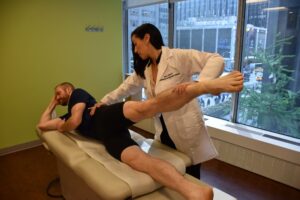

Photo credits to Alison Su Photography
Follow Andrea at @barre.and.brunch.
Visit her website barreandbrunch.com!

Photo credits to HwaYoun Ella Kang
I have trained in classical ballet since age three, and expanded my dance training by joining the competition dance team in high school, performing in musicals in high school and college, studying at the Joffrey Ballet in New York City for a summer intensive, and obtaining one of my minors in Dance in college at Boston University. As a Dance Minor, I was part of a student performance group called Dance Theatre Group, choreographed and performed aerial dance pieces- including a solo, and took classes in tap, jazz, improv, dance history, and choreography in addition to continuing ballet. When I was applying for medical schools, I hoped to be in a place where I could sustain my love of dance and performing, since this is such a critical piece of who I am and dancing brings me joy and helps me de-stress. I was thrilled that my medical school, Northwestern University Feinberg School of Medicine, has a Dance Interest Group (DIG) and is in downtown Chicago near many different dance studios! I performed in ballet, contemporary, and hip-hop pieces last winter in our medical school showcase, and choreographed a musical theatre dance piece this summer for DIG and taught it over Zoom. Prior to the pandemic, I usually attended ballet class 1-2 times a week at the Joffrey Ballet. The walk along the beautiful riverwalk feels like a brief break from school and studying, and combined with dance class, leaves me feeling reinvigorated. I have also taken dance classes at other studios in Chicago as well. I have definitely missed being in a studio to take dance classes! During the pandemic, many professional dancers have generously given their time to teach free classes, mostly via Instagram live, so I have been doing a lot of at-home ballet and other dance classes. I am grateful for this opportunity to continue dancing, although I am very limited by space and flooring type in my apartment. I also taught some dance and barre classes – I am a certified barre fitness instructor – to fundraise for COVID relief and social justice organizations.
I am currently in my second year of medical school at Northwestern University Feinberg School of Medicine, and although school is very different right now due to the pandemic, I really enjoy all that I am learning. Before medical school, I worked as a Certified Dermatology Technician over my summer and winter breaks during college, which was great exposure to daily medical practice. I love learning about the world around me and have a deep passion for science, which I dove deeper into as a Chemistry major and Biology minor in college. I also find the human body fascinating, partially stemming from my dance experience and interest. Applying scientific knowledge to help others while learning more about the human body’s injury and healing processes combined these interests, so I was strongly drawn to the field of medicine. Medicine is a unique profession because every day you have new opportunities to learn – from team members, mentors, and patients – and you can apply your training to improve the lives of others, both on a personal level through patient care and a larger societal level through research and advocacy.
I always love the indescribable thrill of being on stage. Since I was only about three years old, I can’t remember the first time that I performed, but my mom has lots of pictures! I danced to “I Feel Pretty” from West Side Story in a green dress with polka-dotted sleeves that I remember thinking was so beautiful, and I also danced to “Tomorrow” from Annie, and did a tap number in a fringe skirt. You can see that the fun costumes were a big draw for me as a child! I do remember that I used to be very shy, and embarrassed that I did ballet because it was often made fun of by kids at school, however I continued to dance because I loved it. However, when I embraced my love of dance and performing, I became more confident and began seeking out more opportunities, both in dance and in other leadership roles.

Photo credits to Bill Parsons
I believe dance helped me prepare for a career in medicine through teaching me valuable lessons in perseverance, teamwork, observation, and collaboration, while developing my creativity and ability to think on my toes (literally and figuratively). Pursuing a dance minor improved my analytical skills through studying the aesthetics, philosophy, and history of dance. Choreography and performance require awareness and trust in my abilities and strengths. Incorporating feedback to improve my skills is a valuable life lesson I’ve gained from performing, and has proven critical to learning clinical techniques. I can specifically recall one defining moment in dance performance that really challenged me. It was my performance of my aerial dance solo that I had choreographed during the spring my junior year of college.
The solo began with a complex drop I’d practiced diligently. My rehearsal had been my best yet, so I started the show feeling prepared and excited. However, during the opening, I unexpectedly flipped over and slid backwards, far down. It was a petrifying moment, and I almost panicked but managed to catch myself. Hanging upside down tangled in fabric and worried I would fall 30 feet headfirst, I was unsure what had gone wrong. I untangled myself eventually, but was so unnerved I had to climb down. Seeing the audience’s eyes on me as I stepped away from the silks in mid-performance, I was frustrated and ashamed. I had been so confident and invested much time and energy, yet felt that I had failed.
As being a dancer is integral to my identity, this caused me to question my abilities, as I had never made such a significant mistake in a performance. In examining what had gone wrong, I realized I had both hesitated and moved my arms incorrectly. Ever since starting aerial dance in college, I had wanted to choreograph and perform a solo. I knew if I caved to fear at that moment, I would never be able to do it again. I was determined to perform my solo, and mustered up my courage to try again.
I struggled to keep calm and was unsure if I could do it. Climbing back up the silks was terrifying; almost every ounce of my body resisted. I was shaking, but focused on being present and making the most of each movement. I took a deep breath and went for it – my drop worked!
When greeting the audience after the show, I was initially embarrassed, but many people approached to say they were impressed when I didn’t quit. This changed my view of my failure; I recognized I could learn from and be proud of my efforts.
When I reflected on what had happened, I’m glad I took time to analyze how I had made a mistake, instead of blaming the slipperiness of the fabric or other external conditions. Taking responsibility was difficult as it forced me to reevaluate my perception of my skills, but it was the only way to move forward. I didn’t panic or let my fear of making a mistake stop me, and focused on resolving the situation. It is essential to analyze mistakes to prevent repeating them. It may not have been my best performance, but it was an even greater feat that I combatted my fears and uncertainty to persevere. I believe the lessons learned from this experience in perseverance and staying calm under pressure will be tremendously helpful in medicine.
On a practical note, when learning the musculoskeletal anatomy, I felt that my dance background and body awareness was very helpful. I could visualize movements or perform them myself to see how muscles, ligaments, tendons, and joints connected and manipulated each other. I have also blended my interests in dance, fitness, health, and wellness with my blog, Barre and Brunch, and by dancing and choreographing for the medical school Dance Interest Group. Besides these skills, having an artistic outlet and background has shaped my character and helps me bring a unique perspective when approaching challenges in school or clinical situations.

For anyone who has an artistic passion and is interested in medicine, please don’t give up that part of yourself. I have found it very helpful to maintain engagement in these interests during medical school, and have heard from those further in their medical careers that having a healthy focus outside of medicine is important during residency and as a practicing physician. Whether that’s by joining or creating artistic groups in school, taking art classes outside of school, practicing your art medium by yourself as a study break, or finding a way to make your studying creative with doodles or videos – any of these are helpful and fun! Neglecting the artistic parts of you that add to your happiness and fulfillment can lead to burnout, which is already a known problem in the medical field. Your artistic interests make you unique, and this individuality will help you connect to patients and be a better provider. Medicine is a busy field in which to study and work, so there may not be a great deal of time to dedicate to artistic pursuits, but finding ways to keep your creativity alive is vital. I have met many doctors who also have artistic hobbies – it is doable!

Follow Dr. Desai at @doctoranddancer.
I started dancing at the age of 6. My first performance was around age 7! I am trained in kathak and bharatanatyam. I have been basically dancing my entire life. My days would be going to school, homework, and dance practice – that included bharatanaty/kathak practice or practicing for upcoming performances/competitions. I had always wanted to be a doctor. For me the two were not one or the either, but being able to excel in school and enjoy my passion for dance. I had always since I can remember thought I would become a doctor. I decided on Emergency Med in high school and started volunteering at my local ER. As I pursued medicine, dancing became a type of movement meditation and stress relief. I tried to find time to dance as much as I could. In high school, I was teaching dance and performing. In college, I co founded UCLA’s hindi film dance team and Southern California’s first intercollegiate bollywood dance competition. I continued my passion for dance in medical school and even up until recently. I joined a dance company for a performance at the Lincoln Center in NYC.
 When was the first time you performed, and what part of that experience do you still carry with you?
Ahh.. when I was around 7 years old! I was so nervous to be on stage with all those people watching! one thing I learned during that performance was to focus on the performance and learn to ignore all the eyes that were on me. I think that was one of the biggest lessons from that performance that I carried with me throughout my dance career.
Dance was my passion and love. I think how I felt after dancing inspired me to continue dancing at every stage of my life. It is a great workout, it is a great stress relief, and it makes me happy. For these reasons, I made sure to incorporate dance no matter where I was in my life or what I was doing in my life. Just like I made time to shower, see my friends, etc during my medical journey… I made similar time for dancing.
I can say do not give up. If you enjoy it, do it and it will make your journey in everything else you do much more successful. I truly believe to accomplish our goals we must be happy and learn to manage our stress and dance helped me with that!

Follow Christina at @Steenagrammm and Elevate Theatre Company at @ElevateTheatreCompany.
1. What is your background in both theater and health? Why did you decide to pursue those two disciplines? (This is more of an introduction, so feel free to expand on these topics!)
I started out in theater in the first grade performing in an original play written and directed by one of the parents of a classmate (she and I are still friends today). That opportunity sparked my passion for the performing arts and it has remained a constant in my life ever since. I performed around the Bay Area throughout my secondary schooling, was a dancer and actress and participated in singing competitions. I perform in all kinds of dance shows and musicals throughout my 4 years of college and once I graduated, I started to pursue performing in regional and community theaters.
My public health interests came a bit later than my passion for the arts, in my last year of college as I was finishing up my degree in Spanish Language with a minor in Political Science. I didn’t want to go into teaching and didn’t really know what I would do with my skills in Spanish language, until after a casual chat with a physician, I discovered the need for interpreter services in the medical setting. I began working for a small free clinic as an interpreter and then moved onto the admitting department of a larger safety net organization helping patients get registered for Medicaid. The majority of my clients were Spanish speaking and I was able to leverage my new degree and skills in the public health setting right away upon graduation.
Realizing that the system was challenging to navigate, especially for those with limited English language proficiency, I wanted to learn more how to make a bigger impact in our public health system. I pursued my Masters in Public Health from UC Berkeley, and began working in health care consulting. Over the past decade, as a healthcare consultant, I’ve supported a variety of programs from interpreter services to equity, inclusion, and diversity; supply chain efficiency to communications and member services. All the while, I’ve also been a performing artist, traveling the country with the North American Tour of Mamma Mia! and in a variety of performing roles around New York City. The eventual fusion of the arts and public health was inevitable for me. And both my health care consulting practice and my performing career helped me to clearly identify what I wanted to create through my company, Elevate Theatre Company LLC.
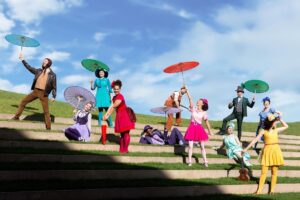
2. When was the first time you performed, and what part of that experience do you still carry with you?
As mentioned, I started performing in the first grade. I believe the experience I love most about the performing arts (and it is true in every show I’ve been a part of), is community. The sense of community one finds when taking text, music, and/or movement, and bringing it to life through a collaborative effort is incredible. It’s amazing how quickly bonds form in the performing arts. I’ve done shows for months and months, and shows for a few days, and each experience has its own unique community that is built on the craft. Community is also what I love about public health. Public health, in my view, is the act of uplifting everyone, engaging a variety of stakeholders for the greater good, and ensuring we all have what we need to thrive. And personally, my community has my back. My community helps me rise to every occasion. My community carries me through everything I do. For that, I’m eternally grateful.
3. Such creative journeys often face great challenges and successes. What event(s) inspired or challenged you personally to pursue theater, and to incorporate it into your health training?
There wasn’t one challenge or inspiration that brought me to pursuing my theater career, but a series of small impactful moments that drove me to making the choice to go for it. For example, working in a corporate setting with sometimes long hours and limited creative outlets, drove me to continue performing in the community outside of work. Performing in the community helped me identify where I needed additional training. Training helped me to realize my passion for performing was more than just a hobby. My first big challenge was transitioning from a full-time public health professional and health care consultant to pursuing a performing arts career more purposefully. I realized I was not going to be able truly have any regrets, if I didn’t really invest fully in my craft. And it was scary. Scary to quit a secure, stable and well-paid job that I actually liked, to pursue something unstable and not well-paid (at least not in the beginning). It was scary to move across the country from California to New York City. And, it was scary to fully commit to calling myself a “performing artist” and not a “public health professional.” I didn’t realize at that time, that I could be both. Overcoming that fear and realizing that I could pursue both my passions simultaneously, was a big and necessary challenge to face.
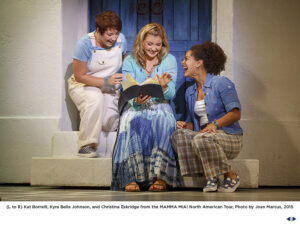
I would also say, a big challenge after pursuing both of my passions separately, was identifying how to fuse them into one. I didn’t know how to articulate what “theater for health” looked like and I didn’t have many, if any, examples of plays or dances, or songs, or performances that had the explicit purpose of improving health literacy or impacting people from a public health lens. So, I had to build what I wanted to see myself. And that is what I’m most proud of. I’ve been able to take my seemingly unrelated experiences in health care and the arts and identify ways that they can complement one another. And, though the impact of the pandemic has been devastating around the globe, I’ve had the opportunity to shape in a purposeful way, what is now Elevate Theatre Company LLC. I’m very proud of creating a theater company with a public health purpose in the middle of a pandemic. I have been on this journey to build Elevate for years, but the pandemic exposed the need for a unique take on health messaging and health literacy. So far, that’s my greatest success, but there’s so much more I want to do!
4. How did the idea behind creating Elevate originate?
I was performing in a show called “Up and Away” with Trusty Sidekick Theater Company. The project was commissioned by Lincoln Center Education as part of their Big Umbrella Festival, a festival of theater programming specifically for kids on the autism spectrum and their families. This show changed my life in so many ways. Not only did it challenge me artistically to open up, lean into improv (which is a scary artform for me), and perform for children (something I hadn’t yet done in my career); this particular show set off a lightbulb in my brain about why I was a performing artist with a Master’s in Public Health. We were not going to cure autism with this performance, but we were impacting the public health of these kids by providing them a safe and tailored space to experience live performance unencumbered by the traditional theater viewing structure. The audience members were able to experience the show in the ways they wanted and needed, and that was an incredible offering. The festival also hosted teaching artists, educators and parents who wanted to learn more about creating arts programming for this audience. It was the fusion of art and tailored practical information sharing among the community. That was where the spark for Elevate was born.
5. In what ways do current events (the pandemic, the BLM movement, etc.) shape the work the theater company does?
Elevate is theater for health. As far as I’m concerned, anything going on in our communities is public health, from the pandemic to our Black Lives Matter movement, from the challenges we face with climate change to the increasing violence against the Asian American and Pacific Islander community. Public health influences everything we do. We’ve covered a variety of topics including: Black women’s reproductive health; isolation, sexual health and safe connections during the pandemic; Black Fatigue; and environmental health and justice, because those are some of the topics impacting our communities today. We want to identify what’s relevant, shed light on it in an artistic way and then provide health and wellness expertise so audiences can walk away with tangible next steps.
6. What’s one concluding piece of advice you can share for those individuals who aspire to merge their passions for health and the performing arts?
I’ve taken gigs in a variety of venues, with different types of people, different experimental artforms and I’ve performed everywhere, from grand and traditional theaters to bars and art galleries and in parks. At first, I thought all those wild venues were just part of the path to Broadway. But now I see that they are the path to something much bigger and greater than anything I imagined before. I thought I was going in one direction, only to discover there was something around the bend I didn’t expect. And now I have a new, bigger dream reaching beyond Broadway. So, don’t ever stop dreaming. Don’t limit yourself. Dream as big as you want to. You can do anything you can imagine. Be bold and pursue things that light you up, even if they don’t seem like they fit together. Find where they mix for you, and follow that path, even when it is unclear. Work hard, be self-aware and pursue all of it with an open mind, an open heart, and a supportive community!
